
"AI Empowers Anti-Counterfeiting in Safety, Quality, and Environment Fields" — Huang Chuangtao, Engineer, CGN Intelligent Technology (Shenzhen) Co., Ltd.
 Scan to share
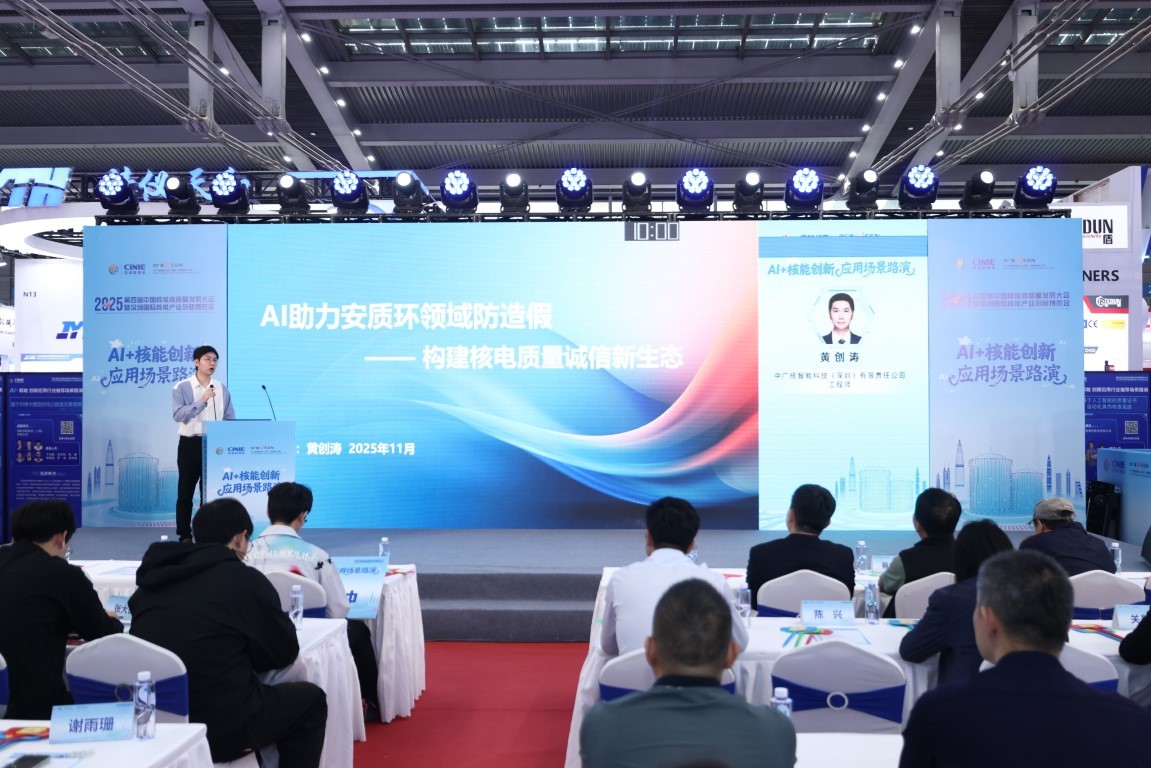
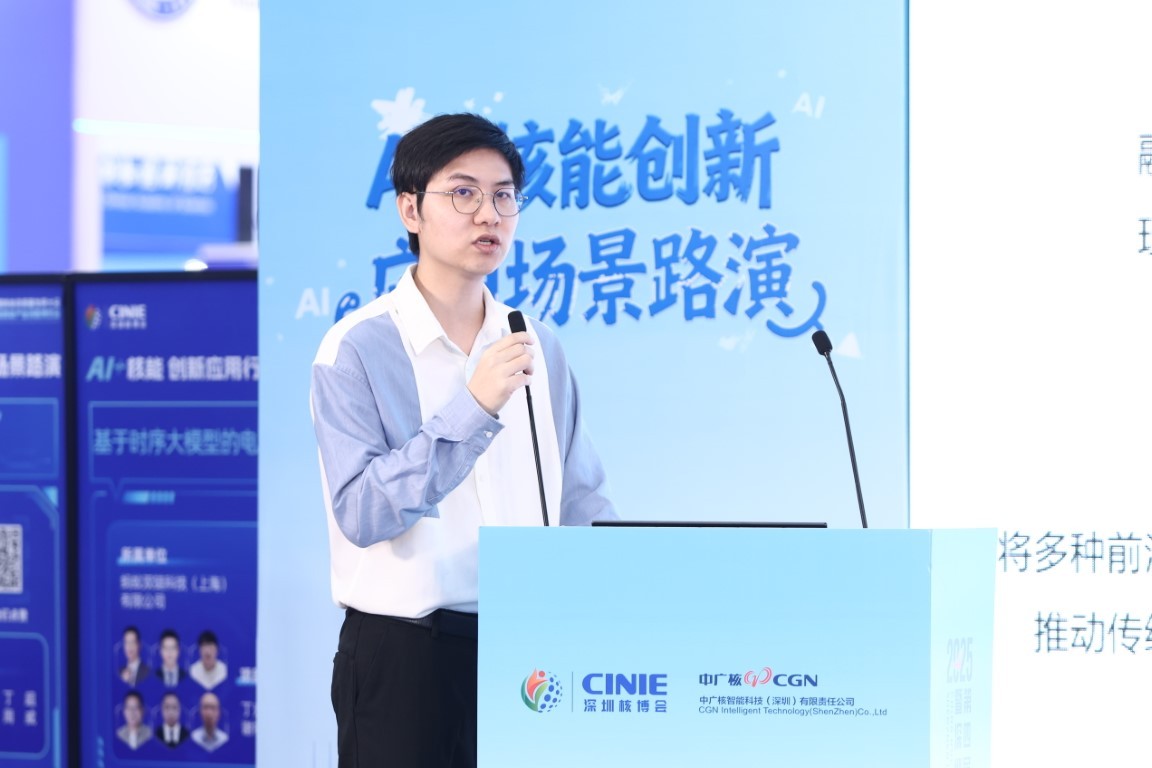
On November 14, 2025, Huang Chuangtao, an engineer from CGN Intelligent Technology (Shenzhen) Co., Ltd., delivered a keynote report titled "AI Empowers Anti-Counterfeiting in Safety, Quality, and Environment Fields" at the "AI + Nuclear Energy Innovation Application Industry-Economy Roadshow" of the Shenzhen Nuclear Industry Expo.
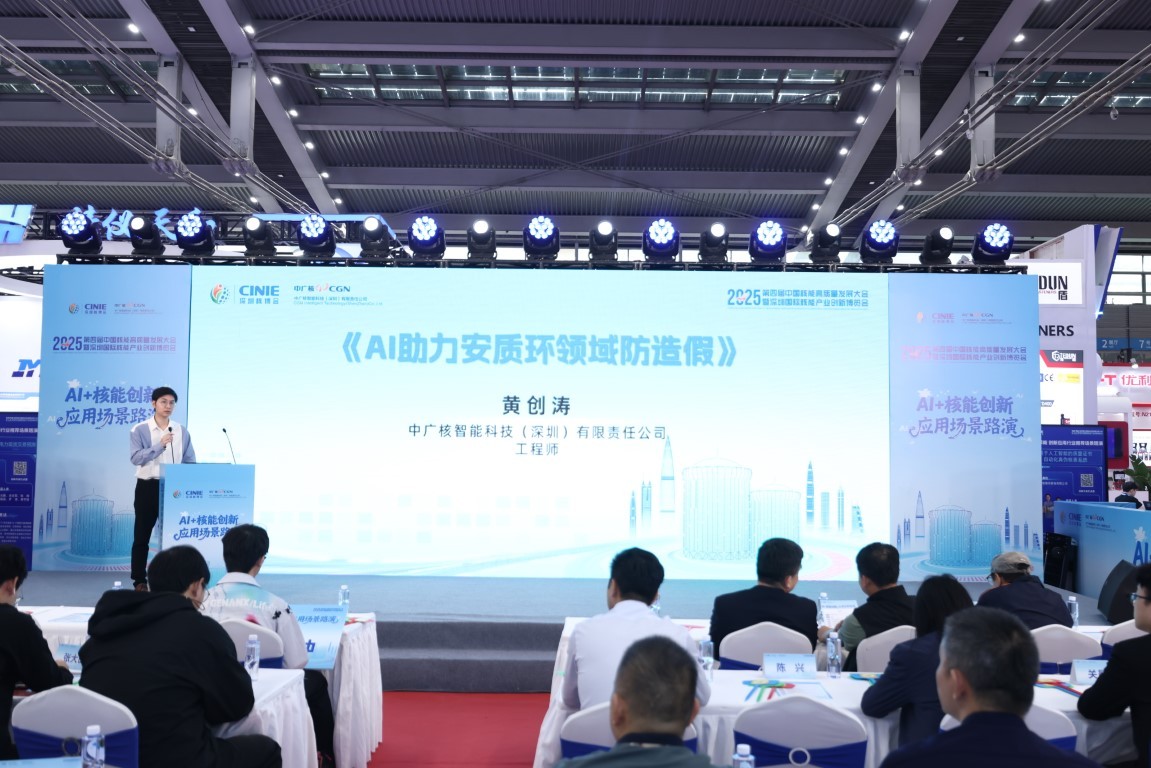
The report introduced the application achievements of using AI to enhance anti-counterfeiting for certificates, qualifications, and quality certification documents in the nuclear power industry. The system employs a layered architecture, multimodal recognition, collaboration between large and small models, and dual verification via QR code links to identify deep counterfeiting, such as simultaneous forgery of certificate content and websites. This solution has completed the verification of over 7,000 certificates, intercepted 17 cases of counterfeiting, and plans to build a traceable quality trust system combined with blockchain.
Key Points
1. Report Theme and Structure (00:00)
The reporter, from CGN Intelligent Technology Co., Ltd., presented the theme of AI-empowered anti-counterfeiting application achievements, covering five aspects: industry challenges, technical architecture, core technologies, application effectiveness, and future outlook.
2. Industry Faces Systemic Certificate Counterfeiting Risks (00:30)
Nuclear power, as a national key energy source, faces issues such as inconsistent certificate standards, difficulty in mutual recognition, rising transaction costs, the evolution of counterfeiting from individual acts to systematic behavior, chaotic standards among third-party agencies, and outdated existing technologies. Certificate counterfeiting has become a core bottleneck restricting industry development, requiring intelligent means to enhance protection capabilities.
3. Three-Layer Technical Architecture Supports Intelligent Verification (01:46)
The system adopts a three-layer design: data platform, data AI intelligent platform, and application modules. The bottom layer integrates official website interfaces and historical samples, supporting incremental synchronization and encrypted storage. The middle layer integrates multimodal capabilities such as OCR, large models, and tampering detection. The upper layer covers scenarios such as metering certificates, personnel qualifications, and quality certification documents, achieving second-level verification and closed-loop management.
4. Multimodal AI Engine and Full-Process Closed Loop (02:30)
The AI middle layer integrates image, text, and semantic capabilities, using cross-validation to determine certificate authenticity from multiple dimensions. The system supports batch import of PDFs, images, and pictures, uses self-trained OCR and NLP for structured processing, interfaces with official websites and databases, and generates audit trails to support review traceability and closed-loop management.
5. Structured OCR and Web Page Parsing Fusion Verification (03:49)
One of the core technologies is the intelligent verification engine that fuses structured OCR and web page parsing. It can extract key information such as certificate numbers and validity periods, cross-validate it with official website information, and automatically highlight discrepancies, improving the effectiveness and accuracy of verification.
6. Large and Small Model Collaboration Improves Accuracy and Efficiency (04:18)
The system uses a lightweight OCR model to quickly extract key certificate information. When the confidence level of the small model is low, it automatically switches to a large model to handle complex scenarios. Through dynamic switching, it balances recognition accuracy and processing efficiency.
7. Dual Verification Identifies Deep Counterfeiting (04:42)
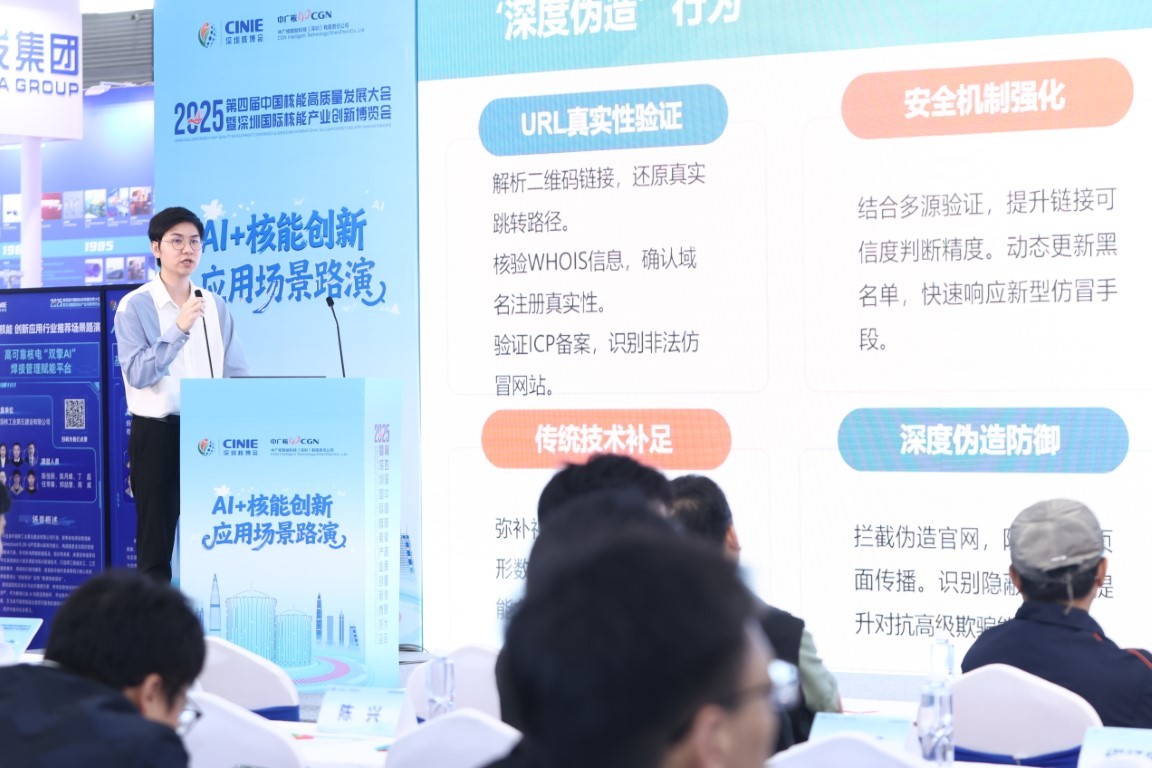
The system has achieved a breakthrough in verifying the authenticity of QR code links, capable of identifying deep counterfeiting where both certificate content and website URLs are forged. Traditional methods only compare certificate content with the corresponding website; if the website is also forged, it is difficult to detect. This solution has successfully intercepted 16 such counterfeiting incidents through dual verification.
8. PC and APP Dual-End Support for Frontline Applications (05:28)
The system has developed both PC and APP applications. The APP supports photo capture and upload, enabling engineers to quickly complete certificate verification and identification in frontline scenarios.
9. Application Effectiveness and Filling Industry Gaps (05:54)
To date, the system has completed the verification of over 7,000 certificates, successfully intercepting 17 counterfeiting cases, 16 of which were highly covert deep counterfeits. By synchronously verifying content and QR codes, the system enhances verification authenticity and fills relevant gaps in anti-counterfeiting within the nuclear power industry.
10. Efficiency, Large-Scale Promotion, and User Recognition (06:29)
Compared to traditional solutions, this system is described as capable of identifying dual forgeries of content and websites. The processing time for a single document is less than 10 seconds, with a daily processing capacity exceeding 100,000 documents, improving efficiency by more than ten times and replacing over 80% of manual operations. It has been promoted to 23 member units of CGN and hundreds of suppliers, embedded in processes such as procurement and acceptance, and is referred to by frontline engineers as a portable "all-seeing eye."
11. Economic Value and Reshaping Supply Chain Integrity System (07:21)
The system saves over 10 million RMB in annual labor costs and avoids over 8 million RMB in compliance risk losses by identifying counterfeits. The solution drives the nuclear power supply chain from post-event accountability to pre-event prevention, achieving traceable certificate verification processes and promoting a shift from passive compliance to active optimization for enterprises.
12. Enhancing Public Trust and Supporting High-Quality Development (08:00)
By ensuring the authenticity and credibility of quality qualifications through technological means, the system helps enhance public confidence in the nuclear energy industry and supports the high-quality development of nuclear power through an intelligent anti-counterfeiting system.
13. Future Integration of Blockchain to Build a Digital Trust Foundation (08:23)
Future plans include integrating blockchain technology to create an immutable, fully traceable quality ecosystem. Through on-chain certification, data anti-counterfeiting, and cross-institutional trust mechanisms, it will extend to scenarios such as full lifecycle management of supply chain equipment, building a digital trust foundation in the quality domain.
14. Expanding from Certificate Anti-Counterfeiting to Nuclear Power Safety Management (08:46)
The project takes certificate anti-counterfeiting as an entry point, aiming to promote the construction of an anti-counterfeiting system in the nuclear power industry, further serve the overall safety management system of nuclear power, and support the development of nuclear power.
Timeline
00:00 - Opening introduction of the reporter, theme, and five-part report framework.
00:30 - Explanation of systemic challenges faced by the nuclear power industry in terms of certificate counterfeiting, inconsistent standards, insufficient regulation, and technological lag.
01:46 - Transition to the system solution, introducing the three-layer architecture, multimodal AI engine, data processing flow, and coverage of certificate types.
03:49 - Focus on core technologies, including structured OCR and web page parsing fusion, large and small model collaboration, QR code link authenticity verification, and dual-end applications.
05:54 - Presentation of implementation results and competitive advantages, emphasizing verification quantity, counterfeiting interception, deep counterfeit identification, processing efficiency, and promotion usage.
07:21 - Summary of economic value, supply chain integrity system construction, enhancement of public trust, and support for high-quality development of nuclear power.
08:23 - Outlook on future integration of blockchain technology to build an immutable, traceable, and cross-institutionally trustworthy quality ecosystem.
08:46 - Conclusion on the project vision: starting with certificate anti-counterfeiting to promote the construction of anti-counterfeiting and safety management systems in the nuclear power industry.
AI Extended Reading (The following content is generated by AI and may contain biases; please discern accordingly):
AI Empowers Nuclear Power Certificate Anti-Counterfeiting: Building a Digital Trust Foundation for the Nuclear Power Industry
Engineer Huang Chuangtao shared the practices of CGN Intelligent Technology in the safety, quality, and environment fields, focusing on "AI Empowers Nuclear Power Certificate Anti-Counterfeiting." The nuclear power industry has extremely high requirements for quality, safety, and compliance. The authenticity of documents such as certificates, qualifications, and material quality certifications directly impacts supply chain integrity and engineering safety. However, current certificate counterfeiting is no longer scattered individual behavior but is gradually showing trends of industrialization, organization, and systematization, posing significant risks to the nuclear power supply chain. Due to inconsistent certificate standards, numerous third-party agencies, and imperfect regulatory mechanisms, the industry faces problems such as difficulty in mutual recognition, high verification costs, and lagging technical means. Traditional manual verification methods can no longer meet the needs for high efficiency, high accuracy, and deep anti-counterfeiting.
To address these pain points, CGN Intelligent Technology has built a layered AI anti-counterfeiting system architecture. The bottom layer is the data platform, responsible for accessing official website interfaces, historical sample libraries, and incremental data, ensuring data security through encrypted storage. The middle layer is the AI intelligent platform, integrating multimodal capabilities such as OCR recognition, large model understanding, and tampering detection, achieving collaboration between large and small models and centralized algorithm invocation. The upper layer consists of business-oriented application modules, covering scenarios such as metering certificates, personnel qualifications, and material quality certification documents, embedded in key processes like procurement and acceptance, achieving closed-loop management from certificate import, intelligent recognition, official website comparison, to anomaly alerts.
The core capability of the system lies in multimodal intelligent verification. It not only recognizes text information in certificates but also combines images, text, semantics, QR code links, and official website data for cross-validation. For different file formats such as PDFs and images, the system can batch import and use self-trained OCR and natural language processing technologies to extract key information such as certificate numbers, validity periods, and issuing agencies, then compare it with official website data and database records. Once field discrepancies, content anomalies, or link inconsistencies are found, the system automatically highlights them, significantly improving the accuracy and traceability of verification.
In terms of technological innovation, this solution adopts a combination of structured OCR and web page parsing, capable of extracting certificate body information and parsing official website page content, achieving automatic cross-validation between certificate files and authoritative data sources. At the same time, the system introduces a large and small model collaboration mechanism. The lightweight OCR model handles rapid recognition in routine scenarios. When encountering complex layouts, poor image quality, or low confidence levels, it automatically switches to a large model for deep understanding and processing, balancing efficiency and accuracy. More importantly, the system incorporates QR code authenticity verification into its anti-counterfeiting logic. It not only checks whether the QR code can redirect but also verifies whether the redirected website is the genuine official website, capable of identifying deep counterfeiting involving "forged certificate content + forged official website links."
The system also provides both PC and APP applications. The PC end is suitable for batch file processing, process approval, and backend management, supporting large-scale certificate verification. The APP end is designed for frontline engineers, supporting on-site photo capture, quick recognition, and instant feedback, facilitating real-time certificate authenticity verification in scenarios such as procurement acceptance, equipment entry, and on-site inspections. This dual-end design extends anti-counterfeiting capabilities from backend management to the operational frontline, enhancing real-time risk prevention and control in nuclear power business processes.
In terms of application effectiveness, the system has completed the verification of over 7,000 certificates, successfully intercepting 17 counterfeiting cases, 16 of which were highly covert deep counterfeits, demonstrating strong practical value. The processing time for a single certificate is less than 10 seconds, with a daily processing capacity exceeding 100,000 documents. Overall efficiency has improved by more than ten times compared to traditional methods, replacing over 80% of manual verification work. Currently, the system has been promoted to 23 member units of CGN and hundreds of suppliers, embedded in key business processes such as procurement and acceptance, and is vividly referred to by frontline engineers as a "portable all-seeing eye."
In terms of value creation, the AI certificate anti-counterfeiting system not only brings significant cost reduction and efficiency improvement effects, saving over 10 million RMB in annual labor costs, but also helps enterprises avoid over 8 million RMB in compliance risk losses by identifying forged certificates. The deeper significance lies in its promotion of a shift in nuclear power quality management from post-event accountability to pre-event prevention, making the certificate verification process recordable, traceable, and auditable, helping enterprises gradually move from passive compliance to active optimization. By ensuring the authenticity and credibility of quality qualifications through intelligent means, it also helps enhance public trust in nuclear power safety and quality management systems.
In the future, this solution plans to further integrate blockchain technology to build an immutable, fully traceable quality ecosystem, achieving on-chain certification, data anti-counterfeiting, and cross-institutional trust collaboration. Taking certificate anti-counterfeiting as an entry point, related capabilities can be extended to broader scenarios such as supply chain equipment management, full lifecycle quality tracking, material traceability, and supplier credit evaluation, gradually forming a digital trust foundation supporting the high-quality development of the nuclear power industry.
Disclaimer: Information republished from partner media, institutions or other websites is provided for reference and communication purposes only. It does not imply endorsement of its views or verification of its accuracy. Please contact us if any content infringes rights or requires correction.