
Ukraine's Nurecab Nuclear Capacity Building Project Completes First Implementation Cycle
 Scan to share
On August 20, 2026, the final seminar of the international project Nurecab ("Nuclear Capacity Building in Ukraine through European Cooperation") was held in Kyiv. The project is funded by the European Union through the Euratom Research and Training Programme and is incorporated into the "Horizon Europe" framework.
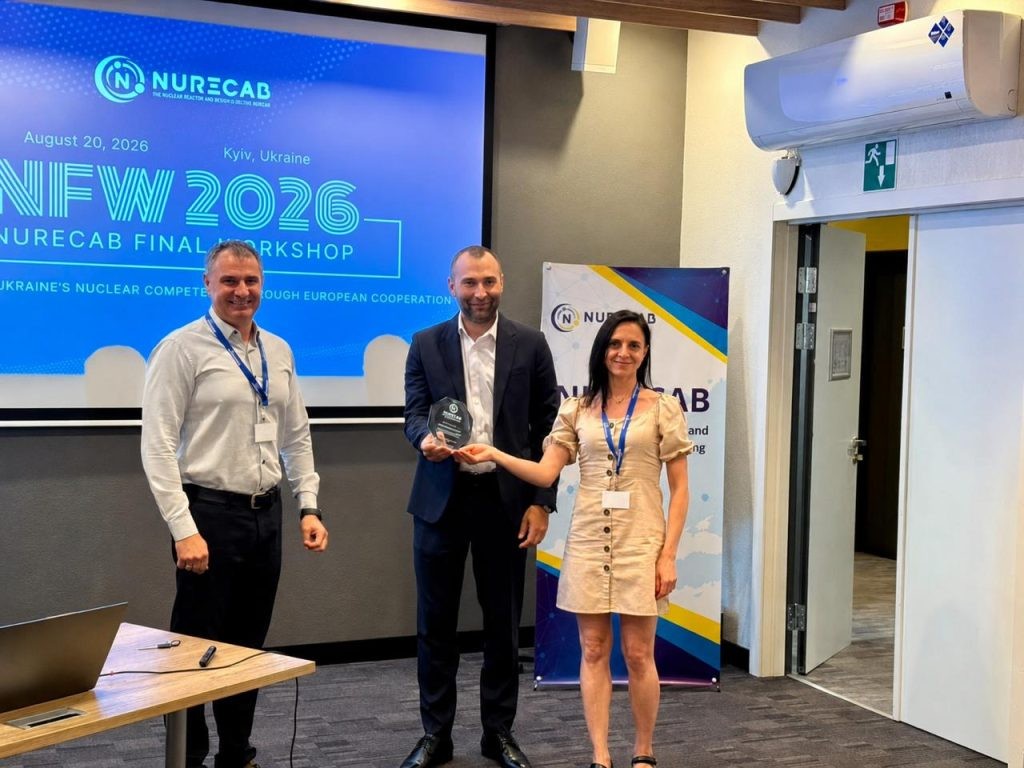
The seminar was held in a hybrid format, with a total of 76 experts, researchers, educators, and representatives of national institutions participating, of whom 26 attended in person in Kyiv and 50 joined via video link. The meeting showcased the project's implementation results and facilitated exchanges on nuclear energy education in Ukraine, the development of nuclear science, and future directions for European cooperation.
The meeting was opened with an introductory speech by Serhiy Pugach, Nurecab project coordinator at the National Science Center "Kharkiv Institute of Physics and Technology". He noted that the project has played a positive role in strengthening Ukraine's human resources, research, and educational capacity in the nuclear field. Representatives from V. N. Karazin Kharkiv National University, NNEGC Energoatom, and the National Academy of Sciences of Ukraine participated in the meeting.
During the meeting, the Ministry of Education and Science of Ukraine, the Delegation of the European Union to Ukraine, the National Research Foundation of Ukraine, and the Horizon Europe Office in Ukraine presented relevant reform measures and tools supporting research and international cooperation. Representatives from the European Nuclear Education Network and the Joint Research Centre of the European Commission also presented developments in human resources for the European nuclear industry.
The seminar focused on reporting the implementation results of the Nurecab work packages, including the needs analysis of Ukrainian higher education institutions, the development of 10 new training courses in nuclear technology, and training programmes for Ukrainian teachers and researchers. The meeting also presented progress on integrating Ukrainian experts into the European research system and their participation in academic mobility programmes.
The development of young talent was one of the key components of the project, primarily implemented by the Ukrainian Nuclear Society. During the project period, the Ukrainian Nuclear Society organized a number of activities for school students, young people, and university applicants, including an interactive competition titled "How a Nuclear Power Plant Works" for 70 high school students from Kyiv, three all-Ukrainian career guidance webinars for teachers, high school students, and parents, a career exchange event titled "Energy Future: Your Career in the Nuclear Industry", and a science popularization activity titled "Nuclear Science Slam".
The project also developed the online platform "My Career in the Nuclear Industry" (career.ukrns.org), providing applicants and students with information navigation services on nuclear specialties, educational programmes, scholarships, and career opportunities.
The final stage of the meeting focused on discussions of the project's dissemination strategy, the overall impact assessment of Nurecab, and prospects for further cooperation. The Ukrainian Nuclear Society stated that it will continue to promote the development of nuclear science and nuclear education in Ukraine and support the growth of young nuclear professionals.
Disclaimer: Information republished from partner media, institutions or other websites is provided for reference and communication purposes only. It does not imply endorsement of its views or verification of its accuracy. Please contact us if any content infringes rights or requires correction.