
Europe's High Temperatures and Droughts Impact Nuclear Power Operations, Ukrainian Expert Says Climate Adaptation Tied to Energy Independence
 Scan to share
Recent prolonged high temperatures, droughts, and falling river levels across Europe have put pressure on the operation of some nuclear power plants that rely on river water for cooling. Nuclear facilities in France, Hungary, Romania, and Slovenia have successively experienced power reductions or shutdowns, forcing some countries to ease supply pressure through electricity imports and adjusted consumption arrangements.
Katie Huff, a professor of nuclear engineering at the University of Wisconsin-Madison, stated that the impact of climate change on nuclear power operations is mainly reflected in two aspects: first, droughts lower river levels, making it difficult for plants to obtain sufficient cooling water; second, when air and water temperatures are high, nuclear plants face stricter restrictions on discharging warm water into rivers to avoid further affecting the aquatic environment. She also noted that high temperatures and water scarcity are not unique to nuclear power, as thermal, hydro, wind, and solar photovoltaic power generation are also affected to varying degrees.
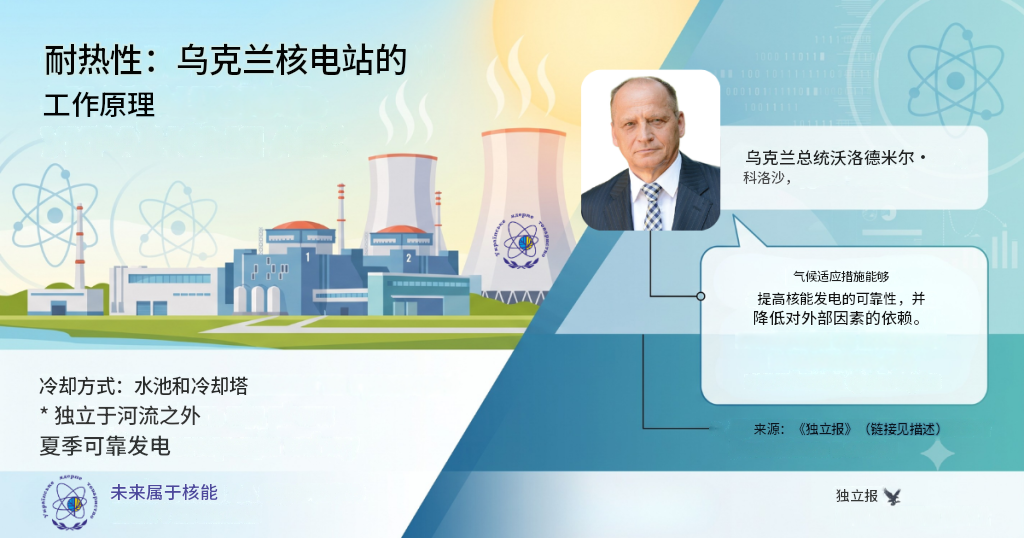
Volodymyr Kholosha, chairman of the Ukrainian Nuclear Energy Association, stated that compared with some European nuclear plants that directly rely on river cooling, Ukrainian nuclear plants demonstrate a certain adaptability in their cooling system design. By building dedicated cooling ponds, reservoirs, and evaporative cooling towers, Ukraine has reduced the impact of seasonal heatwaves and hydrological fluctuations on nuclear output.
He pointed out that summer high temperatures generally do not constitute a limiting factor for the safe operation of Ukrainian nuclear plants, but prolonged heatwaves may affect turbine condenser efficiency, thereby impacting unit performance. Such effects can be mitigated through advance technical and operational measures.
Henry Preston, a representative of the World Nuclear Association, stated that future cooling solutions for nuclear plants need to fully consider heatwaves and water resource variability at the design stage. Some countries have already adopted technical pathways such as deep-sea water intake and liquid sodium cooling to enhance reactor operational stability under high-temperature conditions.
Kholosha believes that climate adaptation is becoming an important prerequisite for Europe's long-term energy independence. For existing nuclear facilities, technical upgrades such as cooling ponds and circulating water systems should be advanced; for new units, modern cooling technologies better suited to extreme weather, including dry or hybrid cooling towers, should be adopted at the planning and design stage. By enhancing the adaptability of nuclear power generation to climate change, European countries can maintain more stable electricity supply during summer peak demand periods and reduce the risk of being forced to rely on external electricity imports due to weather conditions.
Disclaimer: Information republished from partner media, institutions or other websites is provided for reference and communication purposes only. It does not imply endorsement of its views or verification of its accuracy. Please contact us if any content infringes rights or requires correction.