
Purdue University Completes the First Remote Real-Time Autonomous Power Control Experiment on a Nuclear Reactor in the United States, Building a Cross-State Digital Twin Closed Loop
 Scan to share
Purdue University, in collaboration with Idaho National Laboratory (INL) and the University of Illinois Urbana-Champaign (UIUC), has for the first time in the United States achieved remote, automatic, and real-time experimental regulation of nuclear reactor power. The demonstration validated a three-site control closed loop spanning Indiana, Idaho, and Virginia, providing a cutting-edge engineering paradigm for future centralized remote monitoring and automated scheduling of advanced reactors from hundreds or even thousands of miles away.
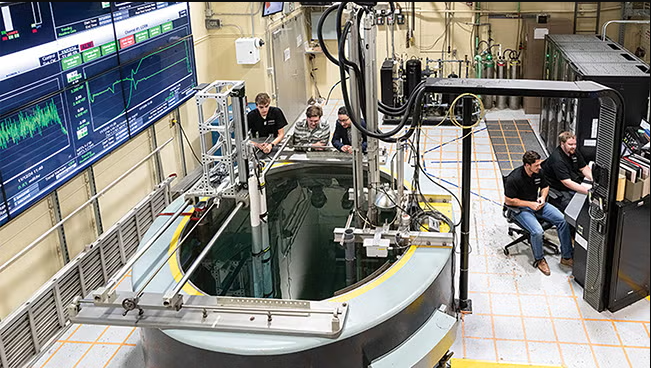
The experiment was conducted using Purdue University's 64-year-old Reactor Number One (PUR-1). This pool-type research reactor, with a rated power of approximately 10 kilowatts (kW), completed its digital upgrade in 2019, becoming the first fully digital digital Instrumentation and Control (I&C) reactor in the United States to receive an operating license from the Nuclear Regulatory Commission (NRC). On this digital foundation, Stylianos Chatzidakis, assistant professor at Purdue University and associate director of PUR-1, led a team to develop a high-fidelity live digital twin in 2023 and integrated a quantum-secure layer in 2025, providing core support for this closed-loop control test.
In this cross-regional closed-loop demonstration, Idaho National Laboratory ran core analysis and prediction models on its high-performance computing cluster located in Idaho, Microsoft Azure provided cloud communication connectivity in Virginia, and the University of Illinois assisted with data flow between multiple nodes. The distributed control system, through INL's DeepLynx advanced data and control platform, the PUR-1 digital twin system, and the supercomputing center, remotely calculated and issued auxiliary control rod displacement commands to the site in Indiana, thereby smoothing minor power perturbations and maintaining stable reactor operation, all without on-site personnel manually intervening in control rods.
The experiment specifically conducted dynamic response simulations targeting the severe load fluctuations that future nuclear power direct supply to large AI data centers may face (such as single power transient demands on the order of 100 megawatts). The research and development team deployed a reinforcement-learning model on the algorithm side to verify whether the system could autonomously complete rapid power-following fine-tuning under the strict constraint of PUR-1's own independent hardware protection system; during the experiment, the reactor's original physical safety interlock protection system always retained ultimate control authority and absolute scram priority.
Chatzidakis emphasized that the near-term application focus of this technology is on fleet-level remote monitoring, such as achieving unified supervision of multiple small modular reactors (SMRs) at the same site from a single centralized control room, or having utility headquarters coordinate and aggregate the operating status and predictive maintenance data of hundreds of SMR units nationwide, thereby significantly reducing operations and maintenance costs. As for highly autonomous operation, on conventional reactors and commercial SMRs, on-site operator staffing will still need to be retained for the long term, and the relevant technological reserves are mainly aimed at extreme deep-space environments such as microreactors on the moon or special application scenarios where personnel cannot be stationed for extended periods.
The results of this experiment not only advance the U.S. Department of Energy (DOE)'s "Genesis Mission" exploring artificial intelligence to accelerate innovation across the full nuclear energy life cycle, but the related practical experience will also be deeply integrated into the INL-led, $60 million "Prometheus" national second-phase nuclear energy research and development program.
Disclaimer: Information republished from partner media, institutions or other websites is provided for reference and communication purposes only. It does not imply endorsement of its views or verification of its accuracy. Please contact us if any content infringes rights or requires correction.