
IAEA Releases White Paper on the Facilitation of the Safe and Secure Transport of Radioactive Material
 Scan to share
During a side event of the 70th General Conference of the International Atomic Energy Agency (IAEA) held in Vienna, Austria, the IAEA Denial of Shipment Working Group officially released and distributed to Member States the White Paper on the Facilitation of the Safe and Secure Transport of Radioactive Material. The white paper puts forward a series of systematic policy recommendations aimed at effectively alleviating the long-standing predicament of denial of shipment or serious delay of shipment in the cross-border transport of radioactive material that has long plagued nuclear power plants, hospitals, industrial non-destructive testing facilities, and scientific research institutions worldwide.
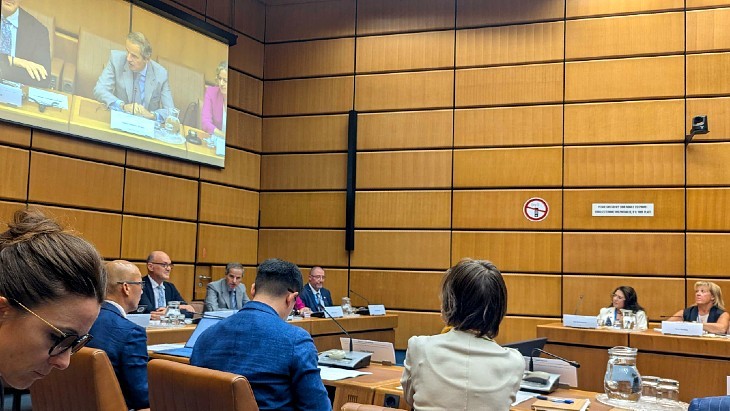
More than 20 million packages of radioactive material need to circulate through transnational and regional networks each year. IAEA Director General Rafael·Mariano·Grossi pointed out at the side event that despite sustained calls from multiple parties in recent years, the problems of cross-border denial of shipment and port detention of radioactive material remain severe; even in friendly countries that support nuclear transport at the policy level, hidden refusals and procedural blockages frequently occur among carrier and logistics companies, exposing deep-seated shortcomings in regulatory coordination and public awareness communication among all parties, which urgently require concerted and coordinated action by global stakeholders to resolve.
Alison·Grant, Canadian Ambassador to Austria and Permanent Representative to the International Organizations in Vienna, emphasized that delays in the transport of radioactive material are not merely a logistical obstacle, but mean the postponement of targeted radiotherapy for cancer patients, delays in clinical medical imaging diagnosis, interruptions in the operation of critical industrial flaw detection, and the suspension of cutting-edge scientific research projects. Peter·Bryant, the outgoing Chief Executive Officer of the World Nuclear Transport Institute (WNTI), also stated that ensuring the smooth transport of radioactive material is essentially about safeguarding the low-carbon energy, food preservation irradiation, and modern medical benefits that the peaceful use of nuclear technology brings to all humanity. King Lee, Head of Policy and Industry Engagement at the World Nuclear Association (WNA), reaffirmed the cornerstone position of transport safety in the entire nuclear fuel cycle chain, and highly affirmed the key bridging role played by countries in restarting the “National focal points” mechanism in emergency coordination.
The white paper was finalized in April this year by a professional working group that served a four-year term. The white paper systematically identifies six core causes of denial of shipment and delays: public perception bias and cultural resistance, insufficient dissemination of basic nuclear knowledge, highly complex regulatory procedures across different jurisdictions, lack of unified coordination of international technical standards and disconnected administrative interfaces, excessive commercial underwriting mechanisms and economic entry barriers, and carrier qualification barriers and breakpoints in multimodal transport networks. The resulting consequences include negative impacts on clinical patient treatment, sharp increases in additional storage and compliance costs, derivative safety and security risks arising from prolonged detention, and hidden risks of regulatory penalties faced by logistics chains.
To fundamentally resolve the above bottlenecks, the white paper clearly proposes eight key mitigation measures for coordinated implementation by Member State governments, nuclear facility operating organizations and industry, and international multilateral institutions, covering core dimensions such as strengthening full-chain transnational communication, streamlining multimodal transport access channels, and improving localized emergency liaison mechanisms. The working group is scheduled to hold its final formal meeting in December this year, focusing on discussing and refining a sustainable governance framework, further clarifying the leading responsibility of Member States as rule-makers, and minimizing through long-term collaborative mechanisms the structural constraints imposed by cross-border denial of shipment on the cause of the peaceful uses of atomic energy.
Disclaimer: Information republished from partner media, institutions or other websites is provided for reference and communication purposes only. It does not imply endorsement of its views or verification of its accuracy. Please contact us if any content infringes rights or requires correction.