
France's ASNR Inaugurates Cadarache Passive Safety Testing Facility
 Scan to share
Recently, the French Nuclear Safety and Radiation Protection Authority (Autorité de Sûreté Nucléaire et de Radioprotection, ASNR) officially inaugurated and commissioned a new passive safety system research infrastructure at the Cadarache Research Center. The core objective of this project is to provide essential scientific data and technical support for the independent safety review of innovative reactors and small modular reactors (SMRs).
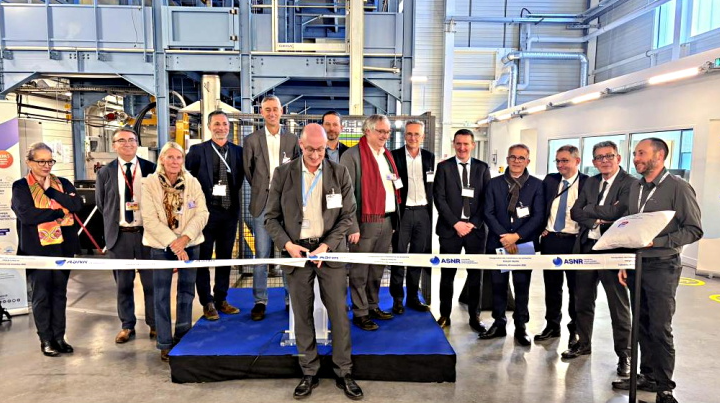
Passive safety systems are designed to safely shut down the reactor and maintain a safe state over the long term without human intervention and with minimal reliance on external support functions. Integrated passive systems are a key direction for current nuclear power design and operating companies developing next-generation reactors. In 2016, the former French Institute for Radiological Protection and Nuclear Safety (IRSN, which merged with the French Nuclear Safety Authority ASN in January 2025 to form ASNR) conducted in-depth research and made recommendations on the safety benefits and reliability of passive systems based on natural phenomena (such as convection and condensation). On this basis, ASNR considers it necessary to conduct forward-looking research to gain an in-depth understanding of the relevant physical phenomena, thereby preparing technically for the safety review dossiers to be submitted by future nuclear operators.
To this end, the PASTIS (Passive Systems Thermalhydraulic Investigations for Safety) project was established to study the complex physical phenomena involved in passive safety systems used to remove residual heat under accident conditions in light water reactors. The project has received €9 million (approximately US$10 million) in funding from the France 2030 plan, with a total budget of approximately €12.8 million. Experiments conducted on this platform will generate key reference data to deepen understanding of physical phenomena, improve the reliability of safety assessment models, and precisely evaluate the performance of passive systems for heat removal under accident scenarios in future SMRs and other innovative reactors.
The PASTIS project focuses on two major research directions: first, convection phenomena in passive system loops (primary and secondary circuits) under accident conditions; second, convection and condensation phenomena inside containment vessels immersed in large volumes of water under accident conditions (such as SMR reactor containment immersed in a pool). The new research facility at Cadarache consists of two modular, extensible experimental platforms: the ALCINA thermal-hydraulic loop, primarily used to measure pressure drop in pipes under forced convection and natural circulation; and the KoKoMo (COndensation in a COntainment MOdel facility) sealed containment platform, used to study convective motion and wall condensation (particularly the coupling effects of condensation and stratification).
The related experimental research and code validation work will be fully underway this year and will be open to domestic and international partners. The knowledge gained will be specifically used to optimize France's existing numerical simulation tools (such as the CATHARE software for normal and accident operation, and the ASTEC software for severe accidents). Meanwhile, the project has engaged in extensive cooperation with the national team of Électricité de France (EDF R&D) and international partners such as the EASI-SMR project funded by the EU's Euratom program.
Disclaimer: Information republished from partner media, institutions or other websites is provided for reference and communication purposes only. It does not imply endorsement of its views or verification of its accuracy. Please contact us if any content infringes rights or requires correction.