
Finland's Posiva Authorized to Operate the World's First Deep Geological Repository for Spent Fuel
 Scan to share
Finnish radioactive waste management company Posiva has officially received an operating license from the Finnish government to operate the spent fuel encapsulation and final disposal facility at Olkiluoto. The facility thus becomes the world's first spent nuclear fuel repository to receive such an operating license.
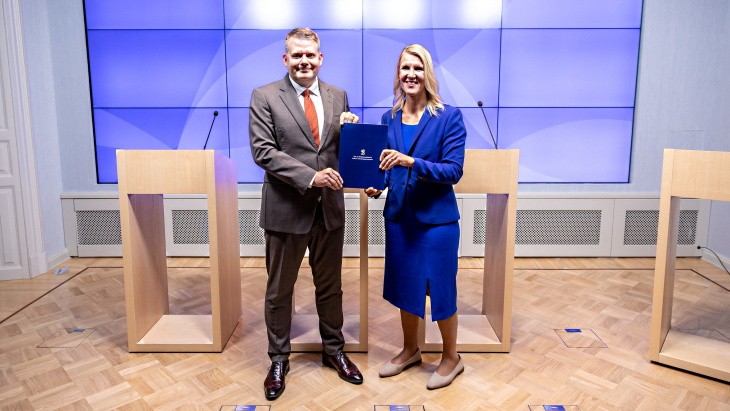
On December 30, 2021, Posiva submitted an operating license application to the Finnish Ministry of Economic Affairs and Employment for the spent fuel encapsulation plant and the Onkalo final disposal facility, with the requested operating period running from March 2024 through the end of 2070. The encapsulation plant and final disposal facility are dedicated to disposing of spent nuclear fuel generated by the Olkiluoto nuclear power plant owned by Teollisuuden Voima Oyj (TVO) and the Loviisa nuclear power plant owned by Fortum.
As a prerequisite for the Finnish government's final decision, the Radiation and Nuclear Safety Authority (STUK) officially issued its safety assessment report on August 4 this year, confirming that the facility meets all safety requirements set out in the Nuclear Energy Act and related decrees, and that there are no radiation or nuclear safety obstacles to granting the operating license. The Finnish government formally issued the license after fully taking the regulatory opinion into account.
Under the terms of the license, Posiva is authorized to possess, handle, store and dispose of up to 6,500 tonnes of uranium (tU) of spent nuclear fuel from the Olkiluoto and Loviisa nuclear power plants, equivalent to the capacity of approximately 3,300 disposal canisters. The license also covers the disposal of low- and intermediate-level waste generated by the facility's operation and the decommissioning of shareholders' nuclear facilities, with a total volume not exceeding 3,000 cubic meters, and permits limited acceptance and disposal of specific radioactive waste generated by domestic medical and research institutions in Finland. According to the plan, once fully operational, the disposal facility is expected to dispose of a maximum of 60 disposal canisters per year, with disposal operations expected to continue until the 2120s, after which the repository will be backfilled and permanently sealed, and subsequent responsibility for the spent fuel will be transferred to the state in accordance with the law.
Before formal operation begins, STUK will still carry out necessary inspections under Section 20 of the Nuclear Energy Act to ensure that all conditions for safe operation are met, and Posiva may not start operations before these inspections are passed. In addition, the company must submit periodic safety assessment reports and updated long-term safety case materials to the regulatory authority within ten years of being granted the license.
Finnish Minister of Climate and the Environment Sari Multala stated that Finland's stringent safety culture provides a solid foundation for clean energy production, and that ensuring the safe and responsible use of nuclear energy—from construction to final disposal of spent fuel—is a major responsibility spanning generations. Posiva President and CEO Ilkka Poikolainen noted that the granting of the license marks a new phase for this systematic project that has lasted more than 40 years, and that the company will carefully complete final commissioning and inspections and steadily advance production operations for the coming century.
The Onkalo deep geological repository is located in bedrock at a depth of about 450 meters and employs a multi-barrier engineered barrier system consisting of tightly sealed copper-iron disposal canisters, a bentonite buffer layer, swelling clay backfill material and the natural rock mass. The project has been advancing steadily since site selection was completed in 2000 and construction was approved in 2015, and drilling of the first final disposal hole was officially launched in late August this year. Over the expected century-long operating period, approximately 100 disposal tunnels will be excavated, with the total length of underground tunnels reaching about 35 kilometers.
Disclaimer: Information republished from partner media, institutions or other websites is provided for reference and communication purposes only. It does not imply endorsement of its views or verification of its accuracy. Please contact us if any content infringes rights or requires correction.