
Norway Funds Pilot Project for Marine Micro Nuclear Reactor Propulsion
 Scan to share
Recently, the Research Council of Norway has officially provided NOK 20 million in funding support to the Norwegian branch of Emerald Nuclear, a startup headquartered in Seattle, United States, to jointly lead the Marine Nuclear Power Propulsion System (MarNuPS) pilot project, comprehensively promoting the deep integration of small nuclear reactors in commercial shipping and offshore operations.
The project core adopts Emerald Nuclear's 5 MWe Gem High-Temperature Gas-Cooled Reactor (HTGR) design, using tri-structural isotropic (TRISO) fuel particles made from high-assay low-enriched uranium (HALEU). The system abandons traditional heavy steam turbines and instead couples with a supercritical carbon dioxide ($\text{sCO}_2$) thermal engine or gas turbine designed by Peregrine Turbine Technologies, which can efficiently respond to rapid fluctuations in marine power demand while maintaining high efficiency comparable to modern marine diesel engines, and adopts a lease operating model with complete replacement every 5 to 15 years.
The entire pilot program is divided into multiple key phases, with the first phase of testing officially launching in 2027. Before actual sea trials, the team will build a fully integrated full-scale land-based marine propulsion system replica at Stette near Ålesund, Norway. In the initial phase, electric heating will replace nuclear fuel to completely eliminate radiation risks, comprehensively evaluating power distribution, control systems, and crew interaction performance. The project brings together multiple industry and academic leaders including shipbuilder VARD Group, Vard Electro, mechanical monitoring company Maskindynamikk, the Norwegian University of Science & Technology, and Imperial College London.
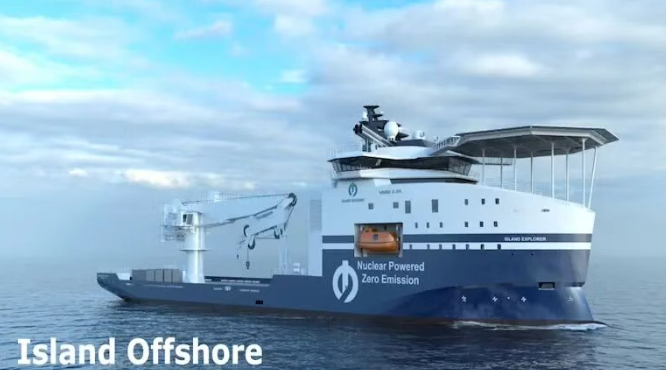
According to the established commercialization timeline, the nuclear propulsion system is expected to enter offshore commercial operation between 2031 and 2032, and Norwegian offshore vessel operator Island Offshore has officially signed on as the first offshore commercial deployment shipowner. Although national fiscal allocation accounts for only part of the overall early development costs, and the project still relies on private capital support, reliable fuel supply chain construction, and complex regulatory approval processes, the steady progress of this project is opening up a highly promising new path for the global maritime shipping industry's transition to carbon-free clean energy.
Disclaimer: Information republished from partner media, institutions or other websites is provided for reference and communication purposes only. It does not imply endorsement of its views or verification of its accuracy. Please contact us if any content infringes rights or requires correction.