
South Korea's HD Hyundai Deepens Marine SMR Layout: Joint Industry-University-Research Initiative Establishes Demonstration Center to Accelerate Commercialization Validation of Marine SMRs
 Scan to share
South Korean shipbuilding giant HD Hyundai is comprehensively accelerating the commercialization process of Small Modular Reactors (SMRs). The company recently joined hands with South Korea's nuclear energy industry, academia, and authoritative classification societies to sign a multi-party cooperation agreement, announcing the formal establishment of the “SMR Marine Technology Demonstration Center”, aimed at deeply integrating the construction capabilities of shipbuilding engineering with the cutting-edge research strengths of the nuclear industry and universities, creating a core catalyst for the commercial deployment of marine nuclear power.
The demonstration center brings together a total of 12 industry-university-research units, including the Korean Register (KR), key nuclear energy institutions, and multiple major South Korean universities. Participating parties will integrate and share existing experimental equipment and research infrastructure to maximize the avoidance of duplicate investment and significantly enhance the validation efficiency of key marine SMR technologies; meanwhile, the alliance will jointly tackle key core technologies for marine nuclear power, collaboratively plan national-level major R&D demonstration projects, and actively bid for major special funding led by the South Korean government.
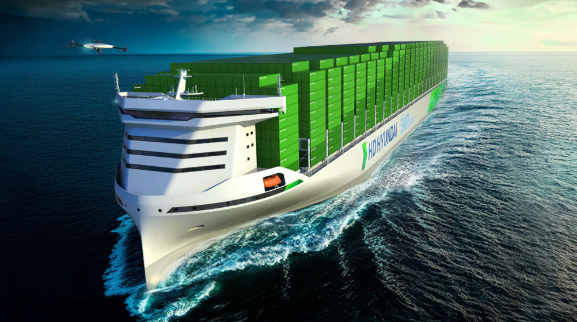
This cooperation is a continuation of HD Hyundai's efforts to promote the development of next-generation nuclear-powered green ships. In 2025, HD Korea Shipbuilding & Offshore Engineering (HD KSOE), a second-tier holding parent company under HD Hyundai, officially unveiled its first 15,000 TEU ultra-large container ship design using SMR as propulsion power, and has successfully obtained an Approval in Principle (AiP) certificate issued by the American Bureau of Shipping (ABS). The design significantly enhances the economic feasibility and inherent safety of nuclear-powered cargo ships by incorporating physical equipment engineering parameters and multiple defense-in-depth safety concepts.
HD KSOE pointed out that the marine SMR propulsion system completely eliminates the exhaust emission treatment system of traditional diesel main engines and the massive heavy fuel oil tanks, greatly optimizing the physical space occupied by the conventional ship engine room, allowing the effective cargo container capacity to be expanded. In terms of radiation protection and containment design, HD Hyundai has innovatively developed a double-hull protective structure——combining a stainless steel double-layer tank with a light water shielding barrier, providing reliable protection for crew and the marine environment. The shipbuilding company also plans to officially inaugurate and put into operation marine nuclear power validation facilities at its Future Technology Research Center in Yongin, South Korea, to comprehensively conduct onshore safety tests for various SMR schemes.
Currently, global shipping and logistics giants' commercial interest in SMR marine propulsion solutions continues to rise. Just last week, South Korea's leading roll-on/roll-off shipping and logistics company Hyundai Glovis announced a strategic cooperation with American logistics company Liberty Global Logistics to launch a joint assessment of the technical feasibility and shipping economics of operating SMR nuclear-powered Pure Car and Truck Carriers (PCTC) on US-South Korea routes.
Disclaimer: Information republished from partner media, institutions or other websites is provided for reference and communication purposes only. It does not imply endorsement of its views or verification of its accuracy. Please contact us if any content infringes rights or requires correction.