
Samsung Heavy Industries and Tesser Atomics Collaborate to Advance Nuclear-Powered Ships
 Scan to share
Recently, South Korean shipbuilder Samsung Heavy Industries and U.S. nuclear technology company Tesser Atomics reached an exclusive strategic cooperation on a transatlantic nuclear-powered liquefied natural gas (LNG) carrier demonstration project. The two parties plan to jointly develop ship concepts and marine reactor applications, integrating Samsung Heavy Industries' capabilities in ship design, integration, and construction with Tesser Atomics' leadership in reactor technology and regulatory licensing, to build a clear path from proof of concept to demonstration and commercial replication.
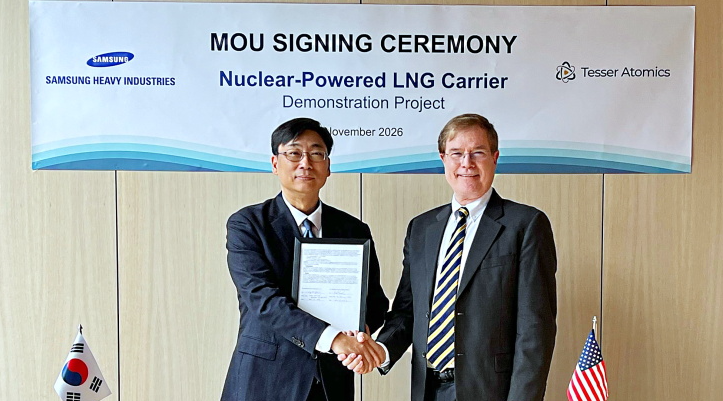
Under the Memorandum of Understanding (MoU) signed in Norway, Samsung Heavy Industries becomes Tesser Atomics' exclusive shipbuilding partner and Tesser Atomics becomes Samsung Heavy Industries' exclusive reactor partner in the first nuclear-powered LNG carrier demonstration project. The project originates from the Norwegian research project "Nuclear Propulsion Vessels" (NuProShip) assessing reactor technology for commercial ships, and continues under the framework of the "SFI SAINT" center, of which Tesser Atomics is a member; the center is led by the Department of Marine Operations and Civil Engineering at the Norwegian University of Science and Technology and supported by the Research Council of Norway, and the demonstration ship is expected to conduct commercial operations between the United States and Europe.
Tesser Atomics' "Triton" reactor is a compact Fluoride-Salt-Cooled High-Temperature Reactor (FHR) designed specifically for ships, combining proven Tri-Structural Isotropic (TRISO) fuel with a low-pressure molten salt coolant and online refueling, providing sufficient propulsion power while meeting marine size constraints. Texas-based Tesser Atomics was co-founded by Per Peterson, who is also a co-founder of Kairos Power and is currently expanding opportunities for "Kairos Fluoride-Salt-Cooled High-Temperature Reactor" (KP-FHR) technology in more markets, while Kairos Power continues to focus on grid-scale power generation deployment.
Per Peterson, co-founder and CEO of Tesser Atomics, said that shipowners need trustworthy nuclear fuel and reactor technology that fits the operating patterns of large cargo ships; the company's reactor uses Tri-Structural Isotropic fuel developed by the U.S. Department of Energy over more than two decades and supports in-operation refueling; Samsung Heavy Industries has decades of experience in LNG carrier design and construction, and it is an honor to work with it to advance the first nuclear-powered ship. Kyunghee Kim, Executive Vice President and Head of the Future Business Division at Samsung Heavy Industries, said that demonstrating nuclear propulsion on a transatlantic LNG carrier will open new horizons for decarbonizing the shipping industry; the project aims to prove that nuclear-powered commercial ships can be deployed on commercial routes, providing a basis for shipowners' next-generation ship choices regarding nuclear propulsion.
It is reported that in September 2025, Samsung Heavy Industries obtained Approval in Principle from the American Bureau of Shipping (ABS) and the Liberian Registry for a 174,000 cubic meter LNG carrier employing a small modular Molten Salt Reactor (MSR); the marine molten salt reactor was jointly conceptually designed by Samsung Heavy Industries and the Korea Atomic Energy Research Institute (KAERI), with a rated thermal power of 100 MWt, and even with only a single unit installed, it can eliminate the need for refueling over the ship's entire service life. The American Bureau of Shipping previously published a study in October 2024 on configuring small modular reactors on a standard 145,000 cubic meter LNG carrier, noting that LNG carriers typically have energy demands between 30 and 75 MW and store natural gas (mainly methane) in cryogenic tanks at approximately minus 165 degrees Celsius; the global shipping industry consumes about 350 million tons of fossil fuel annually, accounting for about 3% of global carbon emissions, and the International Maritime Organization has approved new greenhouse gas reduction targets, striving to achieve net-zero emissions around 2050.
Disclaimer: Information republished from partner media, institutions or other websites is provided for reference and communication purposes only. It does not imply endorsement of its views or verification of its accuracy. Please contact us if any content infringes rights or requires correction.