
NASA Plans to Launch Nuclear-Powered Mars Spacecraft by Late 2028
 Scan to share
Recently, the National Aeronautics and Space Administration (NASA) has officially advanced a cutting-edge deep space exploration program, planning to launch as early as late 2028 the nuclear-powered spacecraft "Freedom" (SR-1 Freedom) to Mars, carrying three Mars helicopters developed based on the "Ingenuity" prototype. "Ingenuity" had previously completed a cumulative 72 flights on Mars. The "Skyfall" mission will continue its exploration experience while focusing on the on-orbit verification of interplanetary nuclear propulsion technology.
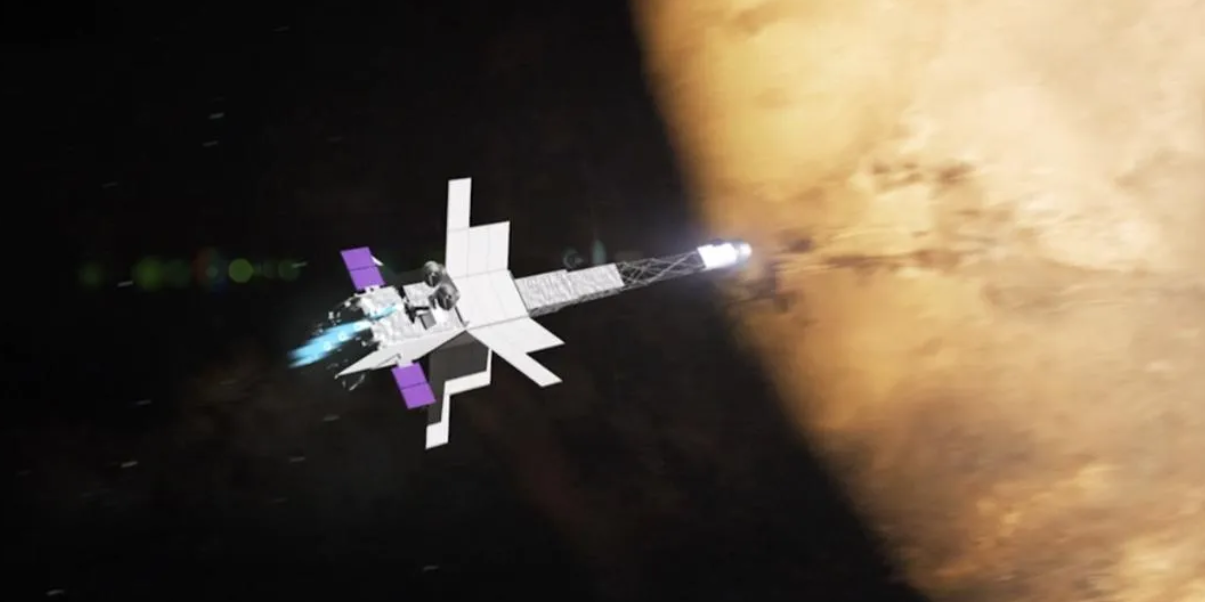
At a press conference held on March 24, NASA Administrator Jared Isaacman outlined the "Skyfall" mission to Mars. Unlike traditional concepts that rely on nuclear thermal propulsion to directly heat a working fluid to generate thrust, the "Freedom" spacecraft will adopt a nuclear electric propulsion technical approach, in which a nuclear reactor generates electricity to power electric thrusters, serving as a technology demonstration payload for future larger-scale deep space missions.
Nuclear propulsion has long attracted significant attention in the space sector, theoretically capable of providing greater thrust and higher voyage efficiency than traditional chemical propulsion. NASA has conducted decades of nuclear propulsion research in laboratories, with one goal being to shorten the journey to Mars to three to four months, approximately half the time required by traditional propulsion methods, thereby reducing astronauts' voyage burden and deep space radiation risks for future crewed Mars missions.
The safety control and launch risks of nuclear fission reactors have always been core challenges facing the engineering of nuclear propulsion. Previously, similar verification projects including the Demonstration Rocket for Agile Cislunar Operations (DRACO) program advanced by Lockheed Martin, as well as those involving the European Space Agency (ESA), ArianeGroup, Airbus Defence and Space, and the French Alternative Energies and Atomic Energy Commission (CEA), all adopted safety strategies of starting the reactor only after reaching orbit or high altitude to reduce launch accident risks.
The "Freedom" spacecraft is likewise planned to be launched by conventional means, with the nuclear propulsion system activated approximately 48 hours later. Due to planetary relative positions, this first nuclear-powered Mars voyage is expected to still take approximately one year; NASA plans to conduct preliminary tests as early as January 2028 and officially launch in December of the same year. External sources indicate that SpaceX's "Falcon Heavy" launch vehicle may undertake the launch mission, but this plan has not yet been officially confirmed.
Disclaimer: Information republished from partner media, institutions or other websites is provided for reference and communication purposes only. It does not imply endorsement of its views or verification of its accuracy. Please contact us if any content infringes rights or requires correction.