
US NRC Details the Bridge Between DOE Authorization and Commercial Licensing
 Scan to share
Recently, the Advanced Reactor Office of the U.S. Nuclear Regulatory Commission (NRC) officially launched a seminar series titled “License to Launch.” The first seminar focused on “Building the Bridge: From DOE Authorization to NRC Licensing,” highlighting how design and operational data from reactors authorized by the U.S. Department of Energy (DOE) or the Department of Defense can be applied through a streamlined pathway to the NRC's commercial licensing process. Previously, the NRC finalized the relevant rule in October, allowing applicants with designs authorized by federal departments to use the streamlined channel, with the rule scheduled to take effect on November 25.
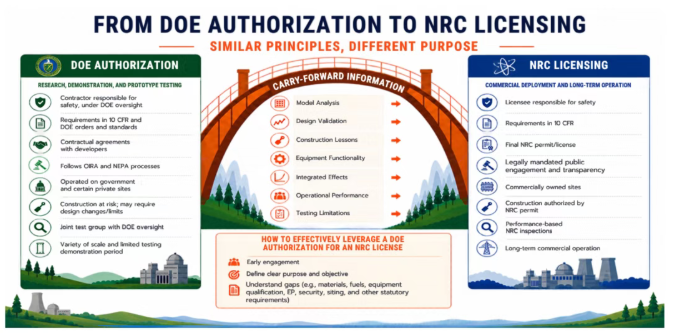
The core topic of the seminar centered on a 158-page white paper written by NRC staff titled "Leveraging Information from Previously Licensed Facilities." The white paper categorizes usable facility information into three tiers: maximum utilization, moderate utilization, and limited utilization. Under the maximum utilization scenario, applicants can directly rely on data collected during DOE authorization; under moderate or limited utilization scenarios, the relevant information primarily serves a supplementary, contextual, or partial reference role.
Matt Hiser, a senior materials engineer at the NRC, reminded industry representatives at the meeting that there are key substantive differences between DOE-authorized facilities and NRC-licensed facilities. Currently, DOE-authorized test facilities or nuclear startup platform projects generally involve limited-duration and limited-scope operation, and their safety analysis reports often do not include the explicit design criteria required for NRC commercial licensing. For example, commercial reactors must consider a 40-year operating cycle and the associated fission product accumulation and fuel cycle issues, which present fundamentally different consideration dimensions compared to test facilities that operate for weeks or months.
According to the white paper, the factors determining the extent to which applicants can ultimately utilize prior data mainly include: the similarity between DOE and NRC requirements and guidance, the reasonableness of the applicant's justification for the relevance of the materials, the safety significance of the information utilized, the depth of the review scope of both agencies, and the quality of the documents serving as the basis for the original authorization.
To bridge potential information gaps, Jackie Harvey, a senior project manager at the NRC, repeatedly emphasized the critical role of "early engagement during the pre-application phase" at the meeting. She noted that the industry should not be intimidated by participating in early communications with the NRC, as in-depth engagement during the pre-application phase enables both parties to quickly reach consensus on the information to be utilized and the content that needs to be supplemented. It is reported that the second seminar in the series will be held in early December.
Disclaimer: Information republished from partner media, institutions or other websites is provided for reference and communication purposes only. It does not imply endorsement of its views or verification of its accuracy. Please contact us if any content infringes rights or requires correction.