
U.S. Team Completes Two-Trillion-Grid Fusion Breeding Blanket Simulation
 Scan to share
Recently, Argonne National Laboratory in the United States announced that a research team composed of multiple leading scientific research institutions has successfully completed the world's largest and most detailed liquid metal fusion breeding blanket simulation to date using two exascale supercomputers, “Aurora” and “Frontier”, achieving a computational resolution of an astonishing 2 trillion grid points. This breakthrough research has successfully been selected as a finalist for the 2026 Association for Computing Machinery (ACM) Gordon Bell Prize.
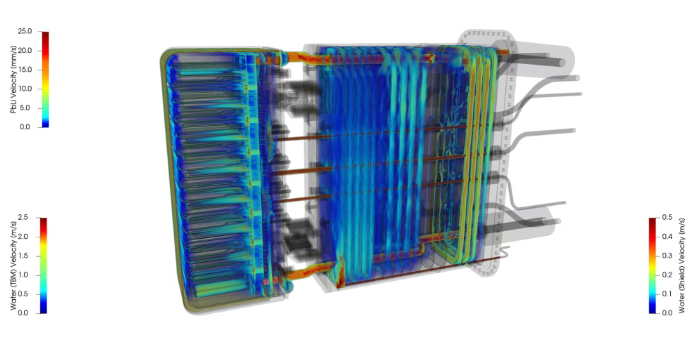
The core object of this ultra-large-scale simulation is a key internal component in magnetic confinement fusion devices——the Breeding Blanket. In a fusion reactor, the breeding blanket shoulders three core missions: capturing the energy released by fusion reactions, protecting the surrounding structures from damage, and producing tritium——the scarce isotope required for fusion——through neutron reactions with lithium. The research team used the Water-Cooled Lead Lithium (WCLL) blanket design adopted by the International Thermonuclear Experimental Reactor (ITER) as a blueprint, and for the first time comprehensively incorporated multiple physical fields and multi-scale coupling mechanisms——including strong magnetic field liquid metal flow, complex heat transfer, buoyancy effects, tritium transport, and water cooling processes——into a single high-fidelity computational model.
To tackle this extreme computational challenge of intertwined multiphysics, a team led by Elia Merzari, professor at Pennsylvania State University and researcher at Argonne National Laboratory, carried out collaborative research relying on Argonne National Laboratory's Aurora supercomputer and Oak Ridge National Laboratory's Frontier supercomputer. After completing code development, testing, and in-situ visualization on the Frontier system, the research team leveraged the massive memory capacity of Aurora, deployed more than 9,000 computational nodes on each of the two systems, and ultimately achieved a historic computational scale of 2 trillion grid points through the open-source computational fluid dynamics software NekRS.
The simulation results clearly revealed the important influence of magnetohydrodynamic (MHD) effects on fluid structures: strong magnetic fields significantly suppress turbulence and cause liquid metal flow to become more laminar, while buoyancy effects generated by internal temperature gradients further alter the heat transfer and flow conditions near the wall region. These high-precision data, spanning from microscopic to macroscopic scales, not only greatly deepen researchers' understanding of the complex physical behavior inside the blanket, but also provide indispensable computational support for reducing fusion experiment costs and accelerating engineering design and optimization validation in the future.
Disclaimer: Information republished from partner media, institutions or other websites is provided for reference and communication purposes only. It does not imply endorsement of its views or verification of its accuracy. Please contact us if any content infringes rights or requires correction.