
U.S. Company Submits Letter of Intent for Reactor Upgrade Technology
 Scan to share
Recently, U.S. nuclear technology company HGP Intelligent Energy (headquartered in Dallas, Texas) formally submitted a Letter of Intent to the U.S. Nuclear Regulatory Commission (NRC), marking the company's software and coolant control technology developed for its pressurized water reactors (PWRs) officially entering the regulatory pre-review stage. This move aims to assist existing U.S. commercial nuclear power plants in achieving stable operation at higher power levels through technological upgrades, in order to meet the surging demand for clean baseload electricity on the grid.
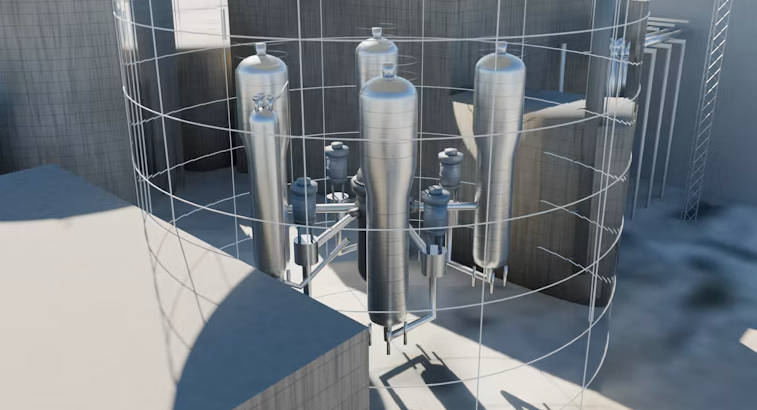
The technical solution proposed by HGP focuses primarily on tapping the incremental power potential of operating nuclear assets through digitalization and flow control means. Currently, across the United States and globally, as artificial intelligence data centers and large-scale computing clusters rapidly escalate demand for continuous, round-the-clock stable power, tapping the surplus capacity of already-built nuclear power plants (i.e., power uprates) is regarded as one of the fastest macro-level energy solutions.
According to the technical roadmap HGP submitted to regulators, the system introduces physics-based plant Digital Twin supervisory control software, paired with variable frequency control technology for reactor coolant pumps. Its core deployment follows a phased approach:
Phase One (pure monitoring mode): The Digital Twin system receives real-time plant operating data through a one-way data diode and runs in parallel in the background to assist operators with condition monitoring and margin prediction. This phase does not connect to the plant control path nor interfere with safety systems.
Phase Two (closed-loop supervisory control): After passing rigorous regulatory review, the system will provide bounded setpoint fine-tuning only for non-safety control functions (primarily regulating reactor coolant flow and turbine load baselines through variable frequency drives), ensuring that core plant safety systems always remain independent.
According to the plan, HGP intends to hold multiple rounds of pre-application meetings with the NRC in 2027, and plans to submit a topical report in the fourth quarter of the same year for Westinghouse-designed pressurized water reactors, providing a regulatory-approved technical reference basis for future plant operators when applying for formal power uprates.
Disclaimer: Information republished from partner media, institutions or other websites is provided for reference and communication purposes only. It does not imply endorsement of its views or verification of its accuracy. Please contact us if any content infringes rights or requires correction.