
US NRC Issues First Construction Permit for High-Temperature Gas-Cooled Reactor
 Scan to share
Recently, the U.S. Nuclear Regulatory Commission (NRC) formally issued a construction permit to the Long Mott Generating Station in Texas. This is the first approval of high-temperature gas-cooled reactor construction in the United States in more than half a century, and the third advanced reactor construction permit issued this year, marking a historic step forward for fourth-generation advanced nuclear technology on the path to commercialization.
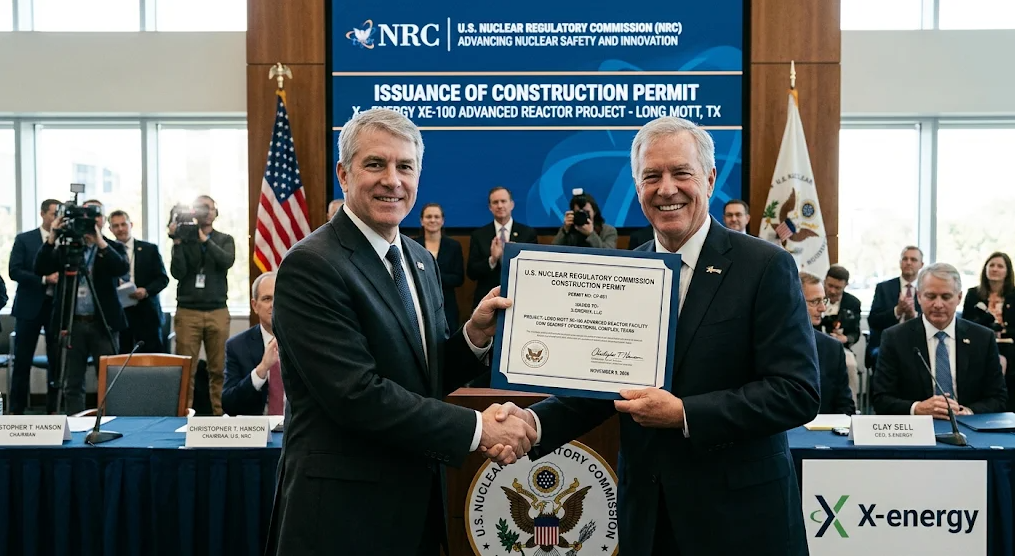
The project is jointly advanced by advanced nuclear developer X-energy and chemical giant Dow, with plans to build four Xe-100 High-Temperature Gas-Cooled Reactors at Dow's Seadrift Operations site in Texas. Once completed, the project will directly provide stable and reliable high-temperature steam and clean electricity to the industrial park, with surplus power fed into the local grid, making it the first advanced nuclear project in the United States to directly empower an industrial site.
In terms of regulatory mechanism innovation, the project fully demonstrates a major breakthrough in risk-informed licensing and review efficiency. The U.S. Nuclear Regulatory Commission completed an environmental assessment of the project's actual impacts in May of this year and issued a “finding of no significant impact,” effectively avoiding the time-consuming and costly preparation of an environmental impact statement under the traditional model; meanwhile, because the Xe-100 reactor design features unique inherent safety characteristics, the approved emergency planning zone radius is only 400 meters. The entire project review process strictly followed the established schedule, with the construction permit successfully issued within the prescribed 18-month review period. NRC Chairman Ho K. Nieh noted that the agency has demonstrated through efficient review the feasibility of advancing advanced nuclear from design to construction on a predictable timeline.
Adam Stein, Director of Nuclear Innovation at The Breakthrough Institute, emphasized that the successful completion of this review shows that the relevant regulatory framework can accommodate the characteristics of advanced reactors. Although the permit only authorizes construction, and a separate operating license is still required before the reactor can formally operate, this milestone establishes an important regulatory and practical precedent for the large-scale commercial deployment of advanced nuclear energy worldwide.
Disclaimer: Information republished from partner media, institutions or other websites is provided for reference and communication purposes only. It does not imply endorsement of its views or verification of its accuracy. Please contact us if any content infringes rights or requires correction.