
NASA Confirms 2028 Nuclear-Powered Lunar Landing Plan
 Scan to share
Recently, the National Aeronautics and Space Administration (NASA) officially announced that it will fully advance the development program of a nuclear-powered lunar rover named the “Polar Observation, Mapping, and In-situ Exploration Rover” (abbreviated as Promise “承诺号”). The rover is expected to successfully land at the lunar south pole in 2028, aiming to search for water ice and other critical natural resources, providing key data support and resource assurance for humanity's future establishment of a permanent residential base on the Moon.
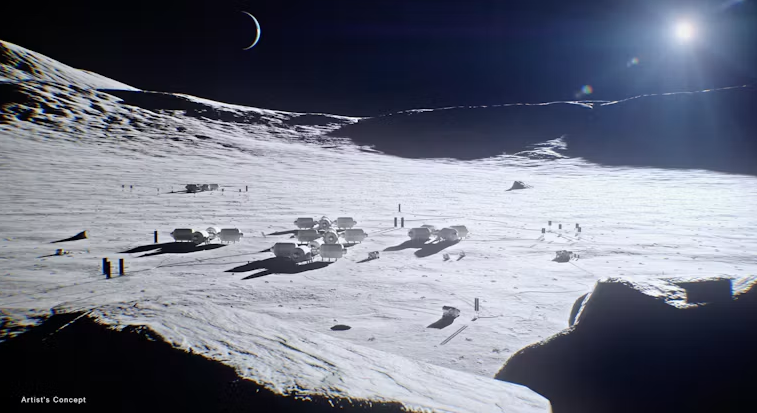
As a heavy-duty lunar exploration rover employing a six-wheel independent drive architecture, “Promise” inherits and continues the mature hardware and mature engineering platform developed for the “Curiosity” and “Perseverance” Mars exploration missions. Its core power system will adopt a radioisotope thermoelectric generator (RTG), which, through the thermal and electrical energy generated by nuclear isotope decay, provides stable and continuous power supply for the rover's long-term operations in the extreme lunar environment.
The introduction of deep space nuclear power greatly breaks through the technical bottlenecks of traditional space exploration. Because the lunar south pole experiences a long lunar night lasting up to two weeks and permanently shadowed regions (PSRs) thousands of meters deep where sunlight never reaches, traditional solar-powered rover not only face severe energy shortages in these areas but are also highly susceptible to permanent damage from extreme low temperatures. Relying on the passive heat generation and all-weather power supply characteristics of its nuclear power system, “Promise” can continuously penetrate deep into permanently shadowed regions for high-intensity drilling and resource analysis.
NASA's deep space exploration team pointed out that the successful deployment of the “Promise” lunar rover at the lunar south pole will directly verify the feasibility of humanity using space nuclear power sources to conduct large-scale scientific investigations in extreme environments without solar radiation. This is not only another important milestone in the application of deep space nuclear technology, but also lays a solid energy and technical foundation for the subsequent construction of a permanent lunar research station under the Artemis program, and even for farther crewed Mars exploration.
Disclaimer: Information republished from partner media, institutions or other websites is provided for reference and communication purposes only. It does not imply endorsement of its views or verification of its accuracy. Please contact us if any content infringes rights or requires correction.