
Yanchao Fusion Energy's Industrialization Path: Can Three-Dimensional Superconducting Magnets Bridge Fusion R&D and Industrial Orders
 Scan to share
Before fusion devices generate commercial electricity, whether R&D teams can first sell magnets to industrial customers is an industrial path worth observing. Shanghai Yanchao Fusion Energy disclosed on October 13 that it completed a Pre-A round of financing worth several hundred million yuan in the third quarter; on November 3, the company further announced the commissioning of its high-temperature superconducting cable production line and the rollout of full-scale cables. From financing to manufacturing, this stellarator enterprise is attempting to advance two tasks simultaneously: validating three-dimensional magnets with experimental devices, and converting part of its superconducting capabilities into industrial products. Whether the two businesses can support each other depends on how much technology can be reused, and what performance customers are willing to pay for.
The steady-state potential of stellarators must first be delivered by three-dimensional magnets
Stellarators primarily rely on external coils to form the three-dimensional magnetic field required to confine plasma, and do not use the maintenance of large-scale plasma current as a basic operating condition, thus offering the physical potential for long-duration operation. However, steady-state potential must be delivered jointly by heating, heat exhaust, vacuum, and magnet systems, and cannot be directly equated with a power plant being able to continuously sell electricity. The more precise the three-dimensional magnetic field, the more the coil shape, position, and deformation after energization must be incorporated into the same error control system.
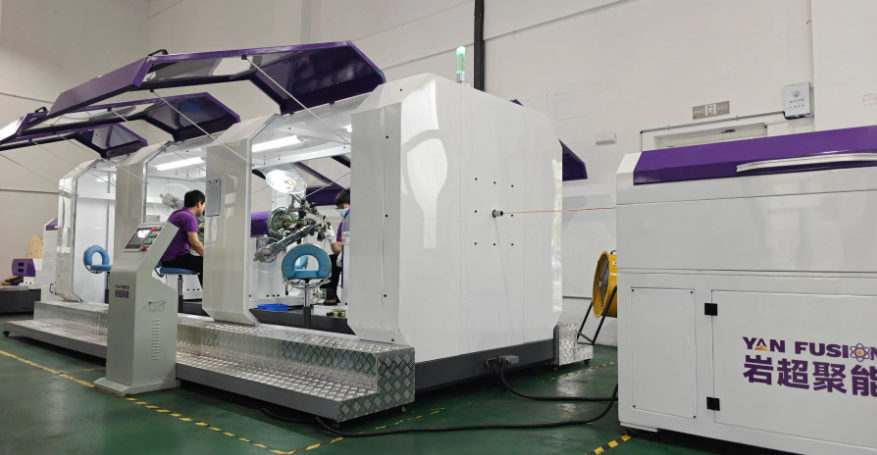
Yanchao Fusion Energy adopts the Cable-in-Conduit Conductor (CICC) approach, encapsulating superconducting cables within metal conduits. The conduit both participates in load-bearing and is linked to the cooling design; the use of high-strength stainless steel means greater mechanical constraints must be overcome during forming. The difficulty lies in the fact that after the conductor is wound into a spatial curve, the internal superconducting material must still maintain current-carrying capacity, and the final magnetic field must meet the design. Winding the shape only proves that the manufacturing chain has cleared one hurdle; it cannot replace cryogenic current-carrying, stress, and protection tests.
Germany's Wendelstein 7-X device provides a meaningful reference: its niobium-titanium superconducting cables use aluminum sealed jackets, maintaining cryogenic temperatures through internal helium cooling. Different jacket materials, superconducting materials, and structural approaches impose different requirements on forming, support, and cooling, and the merits of a route cannot be judged solely on the strength of a single material. The engineering value of Yanchao Fusion Energy should ultimately be reflected in actual performance when cooling, current-carrying, and stress act together, rather than in a single photograph of a complex coil.
From Cable to Joint, the Cryogenic System Must Account for Every Heat Source
The "high temperature" in High-Temperature Superconductivity (HTS) is relative to conventional low-temperature superconducting materials, and does not mean the magnet can operate at room temperature. Fusion magnets still require a dedicated cryogenic environment, and their allowable current is also affected by temperature, magnetic field, and mechanical strain. Making superconducting tape into cables, and then winding cables into three-dimensional coils, each process step may alter final performance. The production line therefore must not only provide length and output, but also demonstrate quality consistency across different positions and batches.
A specific result disclosed by the company in November is that a compact joint made from the rolled-off cable measured a resistance of 1.48 nano-ohms in the liquid helium temperature range. Joints connect adjacent conductors, and even with very low resistance, they still generate heat under large currents. To illustrate the scale, if one assumes a current of 20,000 amperes and assumes the resistance remains at this value, calculating as current squared times resistance, the heat generation is approximately 0.592 watts. This is only a conditional calculation, not an operating condition published by the enterprise; but it shows that heat that is inconspicuous at room temperature also requires serious handling when it appears in deep cryogenic systems.
Evaluating joints also requires consideration of test current, background magnetic field, temperature, measurement uncertainty, and changes after thermal cycling and mechanical loading. The brief information already disclosed is insufficient to independently judge all service conditions, nor can a single joint test be extrapolated to the long-term reliability of an entire magnet system. When a magnet quenches, localized regions lose their superconducting state, and the stored magnetic energy must be controlled; detection and protection must be designed together with the conductor structure. Low-resistance joints are valuable, but complete protection capability is equally indispensable.
Entering Semiconductor Factories, Magnets Must Undergo a Different Set of Inspections
One of the entry points Yanchao Fusion Energy has chosen to move from manufacturing toward revenue is the superconducting magnet required for Magnetic Czochralski (MCZ) monocrystalline silicon growth. An applied magnetic field can influence the flow of conductive silicon melt, providing a means to control crystal growth conditions. International equipment suppliers already offer such products, so it faces an industrial market with real procurement demand and established competitors. Customers care not only about peak magnetic field, but also about magnetic field distribution, equipment footprint, refrigeration power consumption, maintenance convenience, and continuous production line operation capability.
The cryogenic, power supply, insulation, and quality control capabilities accumulated from fusion magnet R&D can provide a foundation for industrial magnet development, but the acceptance criteria of the two markets are not the same. Semiconductor customers need to judge through actual growth processes whether the magnet improves product quality, enhances stability, or reduces overall cost of use. Between completion of a magnet prototype and joint validation with customers, there remain installation adaptation, process debugging, and long-term operational assessment. The prototypes and validation plans disclosed by the enterprise should be distinguished from products that have already achieved stable sales and payment collection.
This gives the commercial arrangement of "fusion devices plus multiple superconducting applications" both opportunities and resource allocation pressures. If industrial orders can cover part of the personnel, equipment, and testing investment, they may ease the financing pressure on fusion R&D; if each application requires redesign, recertification, and building a service team, multiple product lines may also consume cash simultaneously. The several-hundred-million-yuan financing corresponds to the corporate capital investment disclosed in 2026; the specific amount and allocation of uses have not been fully disclosed, making it impossible to calculate product gross margins on this basis, let alone derive future fusion electricity prices.
Device Validation and Customer Acceptance Determine How Far This Path Can Go
The company has proposed that YF-1 be completed by the end of 2027, primarily to validate high-temperature superconducting three-dimensional coils and long-pulse operation capability. This is a phased R&D goal; there remains a distance between completion, first discharge, achieving design performance, and commercial power generation. The role of the device is to subject conductors, magnets, cryogenics, and control to testing within the same system, while exposing interface problems that are difficult to find in individual component tests. Industrial products provide another kind of test: whether equipment, after leaving the R&D workshop, can continue to operate under customers' cost and reliability requirements.
The value of Yanchao Fusion Energy's path must be proven by two sets of results together: whether the experimental device can produce repeatable magnet and plasma operation data, and whether industrial magnets can pass customer acceptance and generate sustained orders. The former validates technology; the latter tests manufacturing and service. Only if the capabilities shared by both are sufficient to cover their respective incremental costs can a multi-business layout potentially extend the support time for R&D investment and accumulate transferable engineering experience; otherwise, it may also disperse limited resources across more targets that remain to be validated.
(This article is based on publicly disclosed technical progress, financing, and product validation reports from Yanchao Fusion Energy, as well as technical materials from the Max Planck Institute for Plasma Physics in Germany and industrial magnet manufacturers. It was independently written after AI-assisted retrieval and organization, aiming to explain the engineering thresholds and commercialization conditions of three-dimensional superconducting magnets. Enterprise test data retain their disclosed attributes; the joint heat generation in this article is a calculation under explicit assumptions and does not represent full-system measured results; device construction timelines are corporate targets.)
Disclaimer: Information republished from partner media, institutions or other websites is provided for reference and communication purposes only. It does not imply endorsement of its views or verification of its accuracy. Please contact us if any content infringes rights or requires correction.