
Chinese Research Team Evaluates Fusion Diagnostic Model Using EAST Discharge Data
 Scan to share
Recently, a joint team from Anhui University and the Institute of Plasma Physics of the Chinese Academy of Sciences proposed a fusion diagnostic model called FusionCLIP. The research team constructed the EAST-MMD dataset using 1,307 discharge records from the Experimental Advanced Superconducting Tokamak (EAST), pairing visible-light videos with multiple diagnostic signals from the same discharge period for model training and evaluation.
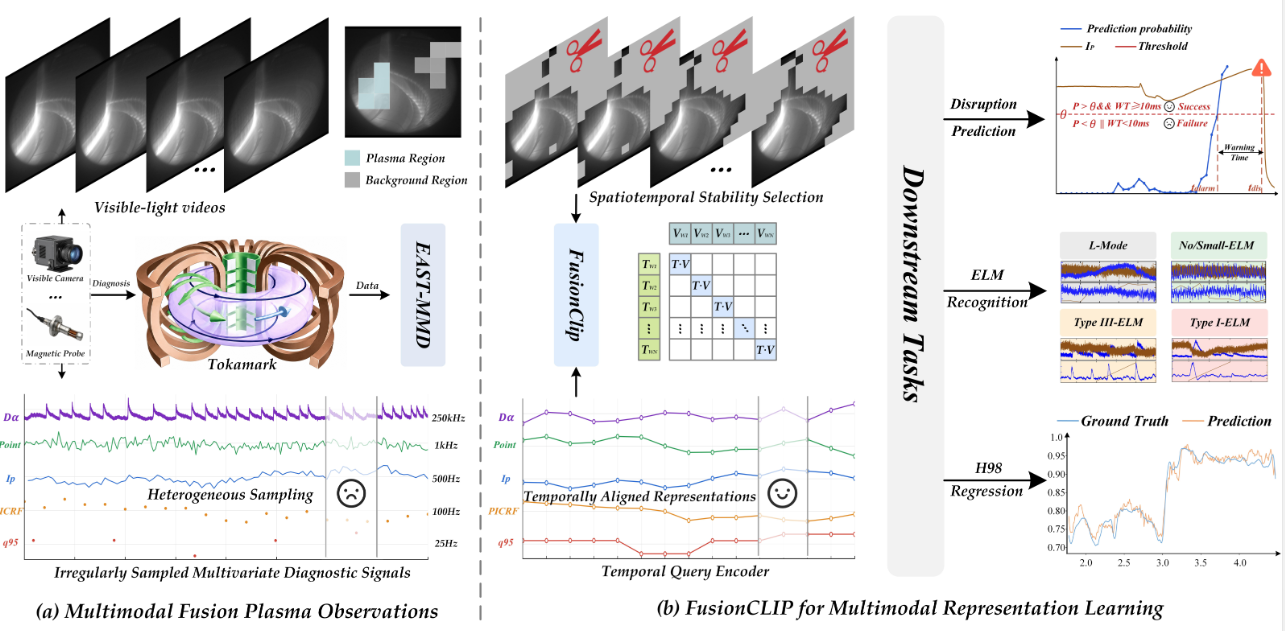
The visible-light videos record the plasma radiation structure and its spatial variations, while the multiple diagnostic signals record the temporal evolution of different physical quantities. FusionCLIP screens regions in the videos relevant to plasma changes and preserves the original sampling times of each variable when processing diagnostic signals. Through contrastive learning, the model associates information corresponding to the same time period across the two types of observations.
Of the 1,307 discharges, 667 were used for pre-training and the remaining 640 for training, validation, and testing of downstream tasks. The researchers separately evaluated plasma disruption prediction, edge localized mode (ELM) classification, and energy confinement performance parameter H98 estimation. FusionCLIP achieved an overall score of 89.07% across the three tasks, 6.27 percentage points higher than the best general pre-training scheme compared in the paper, and 2.12 percentage points higher than a control scheme that also used EAST data for pre-training but did not employ spatiotemporal stability screening.
In the disruption prediction task, the model achieved an F1 score of 93.88% with a false alarm rate of 2.74%. The paper divided training, validation, and test sets by discharge record to prevent different segments of the same discharge from appearing in multiple sets simultaneously. The currently published results come from offline evaluation on historical EAST data; cross-device performance and real-time operational effectiveness remain to be verified.
Disclaimer: Information republished from partner media, institutions or other websites is provided for reference and communication purposes only. It does not imply endorsement of its views or verification of its accuracy. Please contact us if any content infringes rights or requires correction.