
Neural Network Surrogate Model Speeds Up Superconducting Magnet Simulation
 Scan to share
Recently, a domestic research team has achieved an important breakthrough in the field of electromagnetic analysis and design of high-temperature superconducting magnets. The research paper "A Surrogate Model for High-Temperature Superconducting Magnets to Predict Current Distribution with Neural Networks," completed by Professor Qu Timing's team, has been officially accepted by the top journal in the superconductivity field, *Superconductivity*. This research innovatively introduces deep learning into the electromagnetic analysis of high-temperature superconducting magnets and successfully constructs a neural network-based surrogate model, providing a brand-new technical pathway for solving complex current distribution prediction and rapid optimization of magnet parameters.
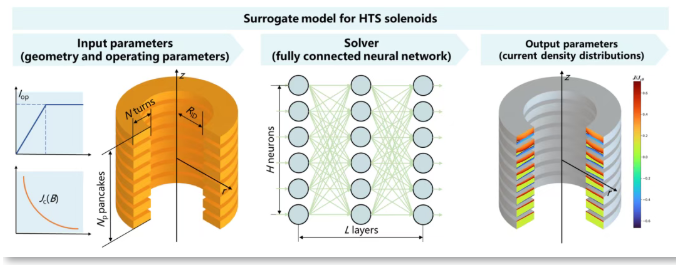
As core equipment for controlled nuclear fusion and strong magnetic field scientific facilities, high-temperature superconducting magnets exhibit non-uniform current density distribution internally due to complex shielding current effects. Although traditional finite element methods offer high accuracy, as magnet scale continues to increase, computation time grows exponentially, severely constraining rapid iteration of design schemes. To address this engineering bottleneck, the research team proposed a surrogate model based on a fully connected residual neural network (FCRN), trained efficiently using finite element simulation data, enabling the model to predict the current density distribution within tapes and calculate AC loss and central magnetic field in seconds based on magnet geometric parameters and operating conditions.
In specific operating condition validation, the model demonstrated extremely high prediction accuracy and computational efficiency. In rapid excitation and steady-state operation tests, the model's relative error in predicting excitation magnetization loss was below 10%, and the average relative error in predicting steady-state central magnetic field was only 1.2%. While traditional finite element methods require several hours to complete one excitation simulation, the trained neural network model can complete current density distribution prediction at a specified time instant within sub-second levels, achieving a qualitative leap in computational efficiency. The outstanding performance of the residual neural network effectively improved the training convergence performance of deep networks, laying a solid foundation for handling complex electromagnetic problems.
On the basis of achieving rapid prediction of electromagnetic characteristics, the research further expanded the practical application of artificial intelligence in intelligent magnet design. With optimization objectives of central magnetic field greater than 16 Tesla (T), central region non-uniformity less than 1%, and reduced superconducting tape usage, the model completed efficient scanning and evaluation of 4265 parameter combinations in only 290 seconds, successfully screening out a high-quality scheme with a predicted central magnetic field of 16.02 Tesla, highly consistent with the finite element calculation result (16.04 Tesla). With the future integration of physical constraints and continuous expansion of training operating conditions, artificial intelligence technology will certainly play an even more critical role in multi-parameter optimization and engineering design of high-temperature superconducting magnets.
Disclaimer: Information republished from partner media, institutions or other websites is provided for reference and communication purposes only. It does not imply endorsement of its views or verification of its accuracy. Please contact us if any content infringes rights or requires correction.