
UK fusion device completes key lift of twelve-tonne dual-beam box
 Scan to share
Recently, the UK's MAST Upgrade spherical tokamak device completed a key engineering operation: the lifting and positioning of a 12-tonne dual-beam box, creating conditions for the installation of new neutral beam heating equipment. The device is located at the Culham campus and operated by the UK Atomic Energy Authority (UKAEA). It is expanding its experimental capabilities through a heating system upgrade to support the physics and engineering research required for future fusion power plants.
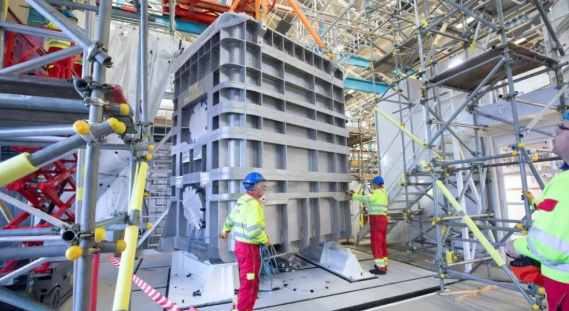
The dual-beam box features a two-tier layout and is designed to house two new neutral beam injectors. The equipment transfers energy by injecting high-energy neutral atoms into the plasma. After the upgrade is completed, the device's neutral beam heating power is expected to increase from 4.4 MW to 8.8 MW, and the plasma temperature target is expected to rise from approximately 30 million degrees Celsius to approximately 60 million degrees Celsius. The higher heating power will give researchers room to explore experimental conditions approaching the requirements of future fusion power plants.
The increased heating capability will also advance heat exhaust research. MAST Upgrade is equipped with a Super-X divertor, which reduces the heat load on plasma-facing components by optimizing the particle and heat exhaust paths. Previous experiments have demonstrated the heat exhaust advantages of this configuration, and subsequent experiments under higher-power conditions will continue to test the performance of the relevant technologies, accumulating experience for the design of the UK's STEP prototype fusion power plant and other fusion devices.
Supporting engineering work around the dual-beam box is progressing in parallel, including the fabrication and installation of beamline modules, cryopump assembly, positive ion injector installation, as well as the relocation and reuse of power supply equipment and the construction of the electron Bernstein wave heating system. The fully assembled box, including the lid, weighs approximately 15 tonnes, has a volume of approximately 20 cubic meters, and is manufactured from 316L stainless steel. After the main hardware installation is completed, the team will commission the vacuum system and related equipment before proceeding to the subsequent scientific experimental phase.
Disclaimer: Information republished from partner media, institutions or other websites is provided for reference and communication purposes only. It does not imply endorsement of its views or verification of its accuracy. Please contact us if any content infringes rights or requires correction.