
German-Italian Team Achieves Acceleration of Tokamak Turbulence Simulation Code
 Scan to share
Recently, researchers from the Max Planck Institute for Plasma Physics (IPP) in Germany and the Polytechnic University of Milan in Italy jointly released a fusion simulation research achievement, successfully refactoring the traditional TRIMEG-C1 code into TRIMEG++, and for the first time fully migrating the main computational components to graphics processing units (GPUs), providing an efficient software implementation solution for scaling up numerical simulations of tokamak devices.
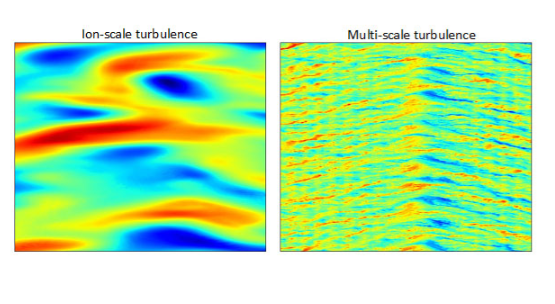
Tokamak turbulence simulation requires real-time tracking and updating of the motion states of massive computational particles. By accurately projecting particle information onto grids and solving complex electromagnetic field equations, the computational cost increases nonlinearly with the expansion of simulation scale. To this end, the research team successfully achieved computational load migration using OpenMP directives, and relied on the GPU backend of the PETSc software library to handle field equations, enabling core high-intensity computational components such as particle pushing, particle projection, and field solving to be efficiently parallelized on accelerator devices.
In performance tests using the TCV-X21 benchmark case, researchers used traditional nodes equipped with two processors and a total of 256 computational cores as the performance comparison baseline. Tests showed that nodes equipped with two AMD MI300A achieved significant acceleration of 4.1x to 6.1x for the entire simulation, while nodes equipped with four NVIDIA A100 achieved acceleration of 2.1x to 3.0x. The tests also revealed that as the number of computational particles continues to increase, the hardware acceleration effect becomes more pronounced, and the memory layout and data transfer methods of different hardware architectures have a significant impact on the overall program performance.
While ensuring a substantial leap in computational performance, the research team conducted in-depth comparisons of output results from different computing platforms, strictly verifying the numerical consistency after code migration, and tested plasma instability evolution in complex cases with and without open magnetic field line regions. This research organically combines outstanding computational performance testing with rigorous physics validation, laying a critical computational software foundation for virtual design and physics experiment prediction of future ultra-large-scale fusion devices.
Disclaimer: Information republished from partner media, institutions or other websites is provided for reference and communication purposes only. It does not imply endorsement of its views or verification of its accuracy. Please contact us if any content infringes rights or requires correction.