
Samsung Heavy Industries and DNV Collaborate on Nuclear-Powered LNG Carrier Development
 Scan to share
Recently, “Samsung Heavy Industries” (SHI), “Tesser Atomics”, the “Norwegian University of Science and Technology” (NTNU), and “DNV” signed a Memorandum of Understanding (MoU) to collaborate on developing a nuclear-powered “Liquefied Natural Gas” (LNG) carrier concept. The agreement was signed at “DNV”'s headquarters in Høvik, Norway, and will explore the design of a demonstration vessel intended to operate between “LNG” terminals in the United States and Europe. The partners will first develop a roadmap covering vessel design, safety assessment, and regulatory approval requirements, with the long-term goal of establishing a viable pathway for the construction and operation of nuclear-powered commercial cargo ships.
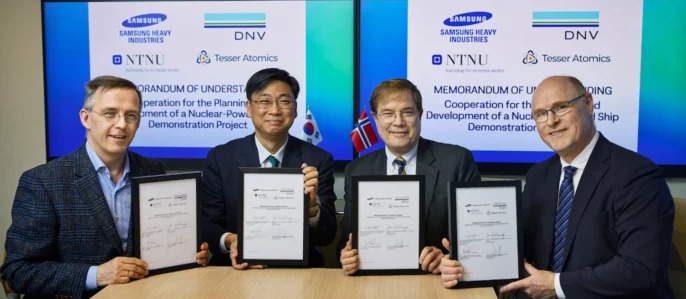
According to reports, the division of responsibilities among the parties is clearly defined. The proposed “LNG” carrier will be designed around a “fluoride-salt-cooled nuclear reactor” developed by “Tesser Atomics”. “Samsung Heavy Industries” will lead vessel design and nuclear power system integration, and will study construction methods and shipbuilding feasibility; “Tesser Atomics” will be responsible for reactor development, nuclear safety, and licensing requirements; “DNV” will provide expertise in maritime safety, risk assessment, and classification rules; and the “Norwegian University of Science and Technology” will coordinate research activities, funding applications, and technical research. The project will also support “SFI SAINT”, the “St. Olav Sustainable Nuclear Shipping Center”, a Norwegian research center focused on nuclear-powered vessels.
Speaking about the significance of the collaboration and technology extension, “Executive Vice President and Head of Future Business Division at Samsung Heavy Industries” Jingxi · Jin (Kyunghee Kim) stated that under the global trend of shipping decarbonization, nuclear-powered vessels are one of the most promising environmentally friendly transportation alternatives, and this collaboration will build on the company's experience in marine “Small Modular Reactors” (SMRs) and advance commercial application. The partners also believe that although the initial project focuses on “LNG” carriers, the technology is expected to expand to container ships and other commercial vessels in the future, and the related research will also examine the technical and regulatory challenges of introducing nuclear propulsion into commercial shipping.
“Director of Approval at DNV” Yiwa'er · Huobeige (Ivar Håberg) stated that the naval sector has a long record of nuclear power applications, but this experience has not yet been translated into commercial shipping practice, and this project is an important step toward building modern full-scale nuclear-powered cargo ships. It is understood that the project is still in the concept development stage, and the partners have not yet announced construction contracts, investment amounts, or delivery schedules. Subsequent steps will depend on the results of feasibility studies and safety assessments.
Disclaimer: Information republished from partner media, institutions or other websites is provided for reference and communication purposes only. It does not imply endorsement of its views or verification of its accuracy. Please contact us if any content infringes rights or requires correction.