
IAEA and University of Saskatchewan Sign Agreement to Strengthen Nuclear Talent Development
 Scan to share
The International Atomic Energy Agency (IAEA) and the University of Saskatchewan recently signed a "Practical Arrangement" to enhance cooperation in nuclear knowledge management, nuclear energy education, research support, and talent development. The agreement was signed on July 24 at IAEA headquarters.
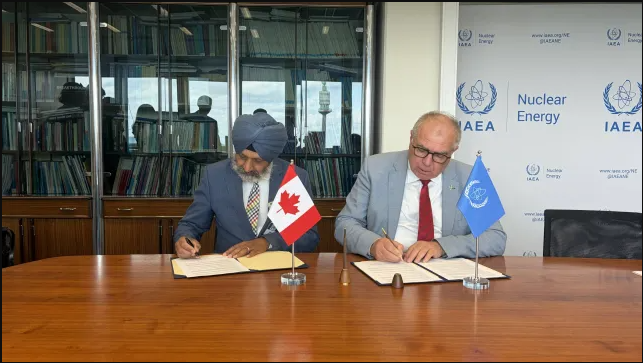
Baljit Singh, Vice-President of the University of Saskatchewan, and Mikhail Chudakov, IAEA Deputy Director General and Head of the Department of Nuclear Energy, signed the "Practical Arrangement" on July 24 at IAEA headquarters. (Photo: IAEA)
Under the agreement, the two parties will advance capacity building through training workshops, expert missions, and educational material development. Cooperation may also include establishing frameworks to integrate IAEA training materials into Canadian university curricula, developing nuclear knowledge management methods, tools, and case studies, and promoting the use of nuclear facilities and research infrastructure in education, training, and capacity building.
Mikhail Chudakov, IAEA Deputy Director General and Head of the Department of Nuclear Energy, stated that the University of Saskatchewan has long contributed to nuclear science development, covering nuclear energy, fusion, and non-energy nuclear technology applications in medicine, agriculture, and hydrology. As global nuclear energy continues to develop, the importance of such cooperation has further increased.
The latest IAEA estimates indicate that, under a high-case scenario, global nuclear power capacity in operation could more than double by 2050. As more countries plan to incorporate nuclear energy into their energy mix or expand existing nuclear power projects, cultivating and maintaining a qualified nuclear workforce has become a key condition for the long-term sustainable development of nuclear power projects.
In June 2026, the University of Saskatchewan, in cooperation with the IAEA, hosted the Canadian Advanced Nuclear Energy Management School. Previously, Canada held its first Nuclear Energy Management School in 2025.
The University of Saskatchewan is home to important research facilities such as the Canadian Light Source, Canada's only synchrotron radiation facility, which can be used for research in advanced materials and other fields, and supports the development of stronger, more durable nuclear reactor components. The facility also serves research directions in agricultural science, medical imaging, and environmental chemistry.
Baljit Singh, Vice-President of Research at the University of Saskatchewan, stated that the agreement will help consolidate the university's existing nuclear research and education foundation and connect local talent and expertise to a broader international cooperation network.
The agreement also covers joint publications in nuclear education, regional and cross-regional networks, and knowledge management, including collaboration related to the International Nuclear Management Academy, which aims to support universities in establishing and offering master's degree programs in nuclear technology management.
Jafar Soltan, Associate Vice-President of Research and Partnerships at the University of Saskatchewan, stated that this agreement will promote the university as a center for nuclear energy training and innovation in Canada and create more cooperation opportunities for the Canadian nuclear industry.
Disclaimer: Information republished from partner media, institutions or other websites is provided for reference and communication purposes only. It does not imply endorsement of its views or verification of its accuracy. Please contact us if any content infringes rights or requires correction.