
Hole of about 3 meters confirmed at bottom of reactor pressure vessel of Unit 3 at Fukushima Daiichi Nuclear Power Station
 Scan to share
Tokyo Electric Power Company (TEPCO) announced on August 27 that a hole approximately 3 meters in diameter has been confirmed at the bottom of the reactor pressure vessel of Unit 3 at the Fukushima Daiichi Nuclear Power Station. The pressure vessel is a steel container that held nuclear fuel before the accident, with a cylindrical shape and a diameter of about 5.5 meters. This is the first time since the core meltdown accident at Units 1 to 3 of the Fukushima Daiichi Nuclear Power Station in 2011 that the specific size and shape of such a hole have been confirmed on the pressure vessel.
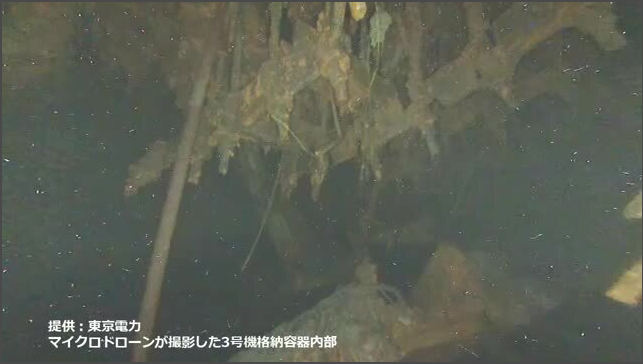
The hole is believed to be related to the falling of melted nuclear fuel during the 2011 accident. After the accident, the containment vessel of Unit 3 has maintained a relatively high water level for an extended period, and access routes into the containment vessel are limited. TEPCO previously used a micro drone weighing approximately 95 grams and measuring about 12 centimeters per side, which entered through a small-diameter pipe on the side of the containment vessel to obtain image data. After three-dimensional reconstruction and analysis, an opening approximately 3 meters in diameter was confirmed at the bottom of the pressure vessel. TEPCO stated that the micro drone briefly entered the interior of the pressure vessel, marking the first time a drone has entered the pressure vessel of the Fukushima Daiichi Nuclear Power Station.
The images show that some structures that should have been inside the pressure vessel before the accident have collapsed, and in the area identified as the bottom of the pressure vessel, icicle-shaped deposits and relatively large block-like objects are visible. TEPCO stated that these materials may contain fuel debris, but a determination cannot be made based on images alone, and further analysis will be conducted in conjunction with data such as radiation levels. The company plans to conduct a second micro drone survey in fiscal year 2026 to confirm the distribution range of fuel debris in Unit 3.
TEPCO has previously submitted materials to the Nuclear Damage Compensation and Decommissioning Facilitation Corporation (NDF) regarding the large-scale fuel debris retrieval plan for Unit 3. The plan envisions inserting equipment through an opening made in the upper part of the containment vessel, using water jets and other methods to cut and crush internal structures and fuel debris, causing them to fall downward into a designated area, and then continuously recovering them through equipment installed on the side of the containment vessel. TEPCO believes that the existing opening at the bottom of the pressure vessel may facilitate the falling of debris and support the design of the subsequent retrieval plan.
Under the current schedule, large-scale fuel debris retrieval from Unit 3 is expected to begin in fiscal year 2037 or later, significantly later than the previously proposed target of "starting in the early 2030s." TEPCO stated that preparatory work, including the construction of related equipment and buildings, is expected to take 12 to 15 years to prevent the spread of radioactive materials.
According to analysis results published by the Japan Atomic Energy Agency (JAEA), the fuel debris sample from the second trial retrieval at Unit 2 of the Fukushima Daiichi Nuclear Power Station shows multiple similarities in composition and structure with the sample obtained in the first retrieval in November 2024. The second sample was obtained in April 2025, at a location approximately 1 meter closer to the center of the containment vessel than the first sample. The analysis shows that both samples contain relatively high uranium content, and components such as zirconium, iron, and nickel originating from fuel cladding tubes and core structural materials were also detected, indicating that the high-temperature molten fuel may have enveloped or mixed with surrounding structural materials during the cooling and solidification process.
JAEA also found numerous micro-cracks in the cross-section of the second sample, and the cause of their formation has not yet been determined, possibly related to the cooling process or internal gas generation. The agency believes that fuel debris formed through similar processes may be distributed near the locations of the two samples, but the condition of deeper regions still requires further investigation.
The Fukushima Daiichi Nuclear Power Station is currently estimated to still contain approximately 880 tons of fuel debris, of which Unit 1 holds about 279 tons, Unit 2 about 237 tons, and Unit 3 about 364 tons. Fuel debris retrieval is regarded as one of the most challenging phases of the decommissioning project. The Japanese government and TEPCO aim to complete the decommissioning of the Fukushima Daiichi Nuclear Power Station by 2051.
Disclaimer: Information republished from partner media, institutions or other websites is provided for reference and communication purposes only. It does not imply endorsement of its views or verification of its accuracy. Please contact us if any content infringes rights or requires correction.