
U.S. Develops Refractory Metal Powder Atomization System to Support Fusion Energy Materials Research
 Scan to share
U.S. researchers are developing a new refractory metal powder atomization system to produce high-temperature alloy powders for extreme-environment applications. The system will support new materials research in areas such as gas turbines, aerospace equipment, and fusion energy systems.
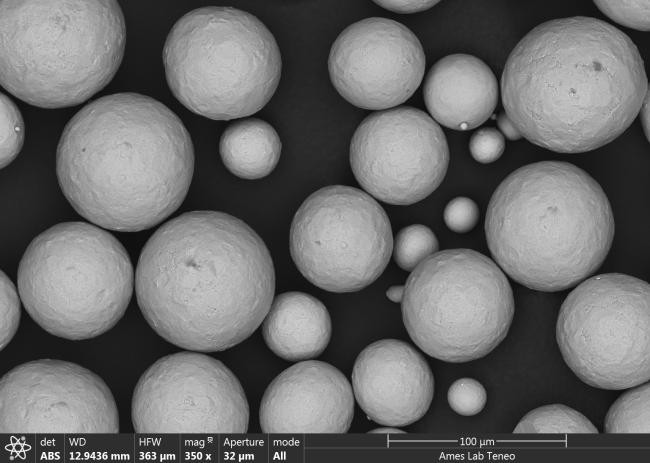
Jordan Tiarks, a scientist at Ames National Laboratory, stated that the laboratory has long been engaged in specialty powder production research, and the new system will expand its materials processing capabilities to higher temperature ranges and more challenging material systems.
The research team explained that metal powders are a critical foundation for advanced manufacturing technologies such as powder metallurgy and additive manufacturing, enabling the precise fabrication of complex components and specialty alloys. For certain high-temperature alloys, conventional processes struggle to meet the powder quality and supply volumes required for research and development. The new system can process materials at temperatures up to 3400°C, with a powder production rate of up to 1 kilogram per minute, helping to provide sufficient samples for new materials development, testing, and scale-up.
Currently, land-based and aerospace gas turbines primarily rely on nickel-based or cobalt-based superalloys. To maintain efficiency at higher temperatures, such equipment typically requires complex cooling systems and costly thermal barrier coatings. Researchers aim to develop new alloys capable of withstanding more severe temperature conditions to improve performance and reduce cooling requirements. Tiarks noted that some research teams have already proposed alloy designs, but obtaining powder materials suitable for testing often involves long lead times.
The Advanced Research Projects Agency–Energy (ARPA-E) believes that the current bottleneck lies not only in the new alloys themselves, but also in the lack of research equipment capable of producing sufficient quantities of high-quality alloy powder. Ames National Laboratory, with years of accumulated experience in powder metallurgy, has therefore taken on the task of building this capability.
According to the team, the new system employs a transferred-arc plasma process that does not require specially fabricated electrodes. Instead, high-energy plasma locally melts the feed material prior to atomization. The feed can take various physical forms, such as rods or blocks, provided the material composition remains consistent. Melting occurs in a water-cooled copper furnace, where the outer layer of the molten material solidifies against the copper wall, forming a thin protective solid structure known as a “skull” that isolates the ultra-high-temperature molten material from the cooled copper wall.
The process melts only a small amount of material at a time. Tiarks stated that localized melting reduces safety risks by avoiding large volumes of ultra-high-temperature metal in a molten state simultaneously, while also shortening the time materials spend at elevated temperatures, which helps maintain purity and control material reactivity.
This refractory metal powder atomizer will complement Ames National Laboratory’s existing atomization equipment portfolio, with a focus on metals and alloys requiring higher processing temperatures. For conventional alloys that can be processed at lower temperatures, the laboratory’s existing induction atomizer and close-coupled atomizer remain more efficient, achieving yields of 50% to 60% in the optimal particle size range. In contrast, the refractory metal powder atomizer typically achieves yields of approximately 10% to 20% in high-temperature alloy powder production.
Disclaimer: Information republished from partner media, institutions or other websites is provided for reference and communication purposes only. It does not imply endorsement of its views or verification of its accuracy. Please contact us if any content infringes rights or requires correction.