
IAEA Publishes Technical Document on Emergency Planning Zones for Small Modular Reactors
 Scan to share
The International Atomic Energy Agency (IAEA) has published TECDOC Series No. 2134 "Technical Basis for the Emergency Planning Zone for Small Modular Reactors"(Technical Basis for the Emergency Planning Zone for Small Modular Reactors). The document was published in Vienna in 2026, comprising 132 pages with 11 illustrations, in English.
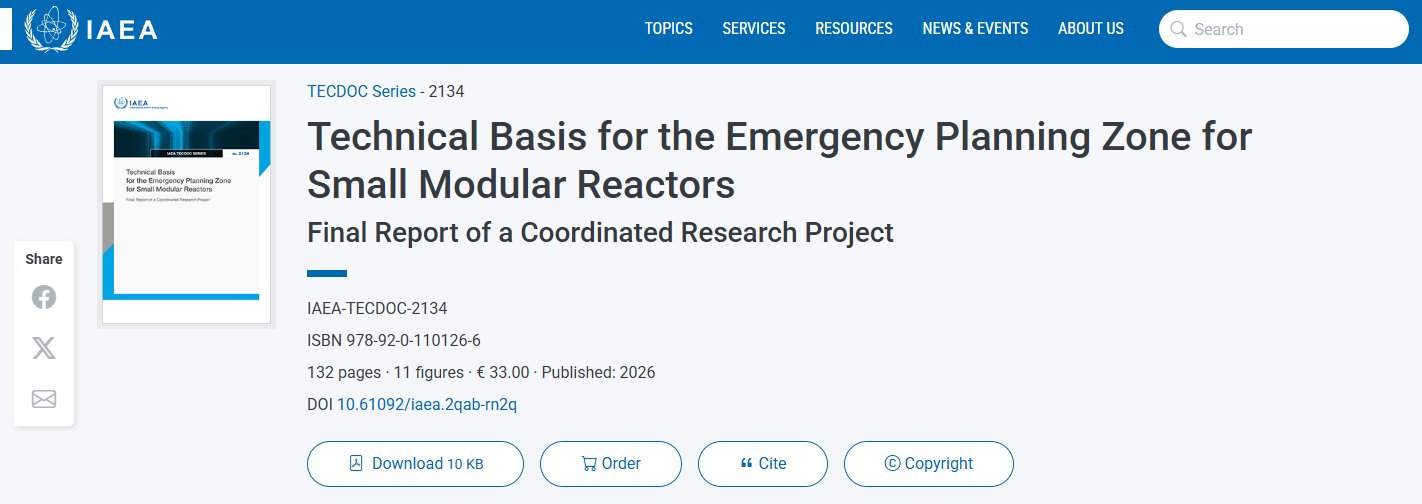
This document marks the first time the IAEA has published the results of a Coordinated Research Project (CRP) on the technical basis for emergency planning zones for Small Modular Reactor (SMR) deployment. The research project was conducted from 2018 to 2021, focusing on how to determine the technical basis for off-site emergency preparedness and response (EPR) arrangements in SMR deployment scenarios, particularly the requirements and scope for establishing emergency planning zones (EPZ).
The document notes that SMRs generally refer to reactors with an electrical output of no more than 300 megawatts per module, whose design, safety, and site characteristics differ from those of traditional large nuclear power units. These features need to be assessed when developing emergency arrangements. In accordance with IAEA safety standards, emergency planning zones mainly include the Precautionary Action Zone (PAZ) and the Urgent Protective Action Planning Zone (UPZ), which are used to take precautionary and urgent protective actions in the event of a nuclear or radiological emergency, to avoid or reduce severe deterministic effects off-site and to reduce public radiation exposure doses.
The publication presents the methods, methodologies, and criteria for determining the technical basis for SMR emergency planning zones, involving factors such as accident scenario selection, source term analysis, atmospheric dispersion modeling, dose assessment, public exposure pathways, population groups, and national dose criteria. The document also discusses the implementation of defense-in-depth in SMR designs, as well as the potential impacts of features such as lower thermal power, smaller radioactive releases, larger safety margins, engineered safety systems, and slower fission product release rates on potential radiation exposure to the public near the site.
The IAEA emphasizes in the document that SMRs are not a single reactor design but rather a collection of technologies encompassing different power levels, coolant types, fuel compositions, safety systems, and modularization schemes. Therefore, different SMR designs may vary considerably in terms of source terms, accident progression, and off-site consequences, and a uniform emergency planning zone scope cannot be simply applied.
Participating institutions in the research project conducted multiple case studies. The document concludes that the emergency planning zone ranges estimated by the relevant institutions are all smaller than the 15 to 30 kilometer urgent protective action planning zone range proposed in current IAEA guidance for light water reactors with thermal power of no less than 100 megawatts. Most estimates are less than 15 kilometers, with some minimum estimates being only a few hundred meters around the reactor and located within what the participating institutions refer to as the site boundary.
The document also notes that the above preliminary conclusions regarding emergency planning zone ranges mainly reflect the views of the participating institutions, are mostly based on predicted radiological consequences, and are not always established on the basis of a complete hazard assessment and predetermined emergency preparedness categories. The IAEA believes that future research on SMR emergency arrangements should further address issues such as non-power applications, urban or remote sites, underground or floating deployments, multi-module co-location, transportation scenarios, probabilistic safety analysis methods, and model uncertainties.
Disclaimer: Information republished from partner media, institutions or other websites is provided for reference and communication purposes only. It does not imply endorsement of its views or verification of its accuracy. Please contact us if any content infringes rights or requires correction.