
Southwest University of Science and Technology Releases Medical Radioactive Waste Treatment Technology Covering Liquid, Gas, and Solid Waste Management
 Scan to share
On August 10, the Mianyang Science and Technology City Strategic Development Research Center held an online innovation achievement release conference, unveiling the "Medical Radioactive Waste Treatment Technology" developed by the School of National Defense Science and Technology / School of Nuclear Science and Technology at Southwest University of Science and Technology. The technology targets radioactive contaminants including liquid waste, off-gas, and solid waste generated during nuclear medicine diagnosis and treatment, offering a full-chain comprehensive treatment solution. The conference attracted 87,000 experts in the nuclear medicine field, departmental representatives, and enterprise users.
With the rapid development of the domestic nuclear medicine industry, insufficient radioactive waste disposal capacity has gradually become a key issue facing the industry's safe expansion. Relevant data show that over 96% of nuclear medicine departments nationwide are constrained by decay tank storage capacity and are forced to limit patient admissions. Based on the current industry growth rate, it is projected that by 2035, the annual generation of nuclear medicine liquid waste in China will rise to 2.2 million tons, potentially further intensifying disposal pressure.
Nie Xiaoqin, Deputy Director of the Innovation Center for Nuclear Environmental Safety Technology under the China Atomic Energy Authority at Southwest University of Science and Technology, noted that traditional storage-and-decay methods suffer from long processing cycles, large footprint requirements, and relatively high leakage risks; conventional adsorbent materials also struggle to adapt to complex nuclide-containing liquid waste with multiple forms, trace concentrations, and high interference. In response to this industry demand, Southwest University of Science and Technology, based on its independently developed enthalpy-entropy synergistic trace nuclide separation theory, has established an innovation system spanning core materials, complete equipment, engineering applications, and standard output.
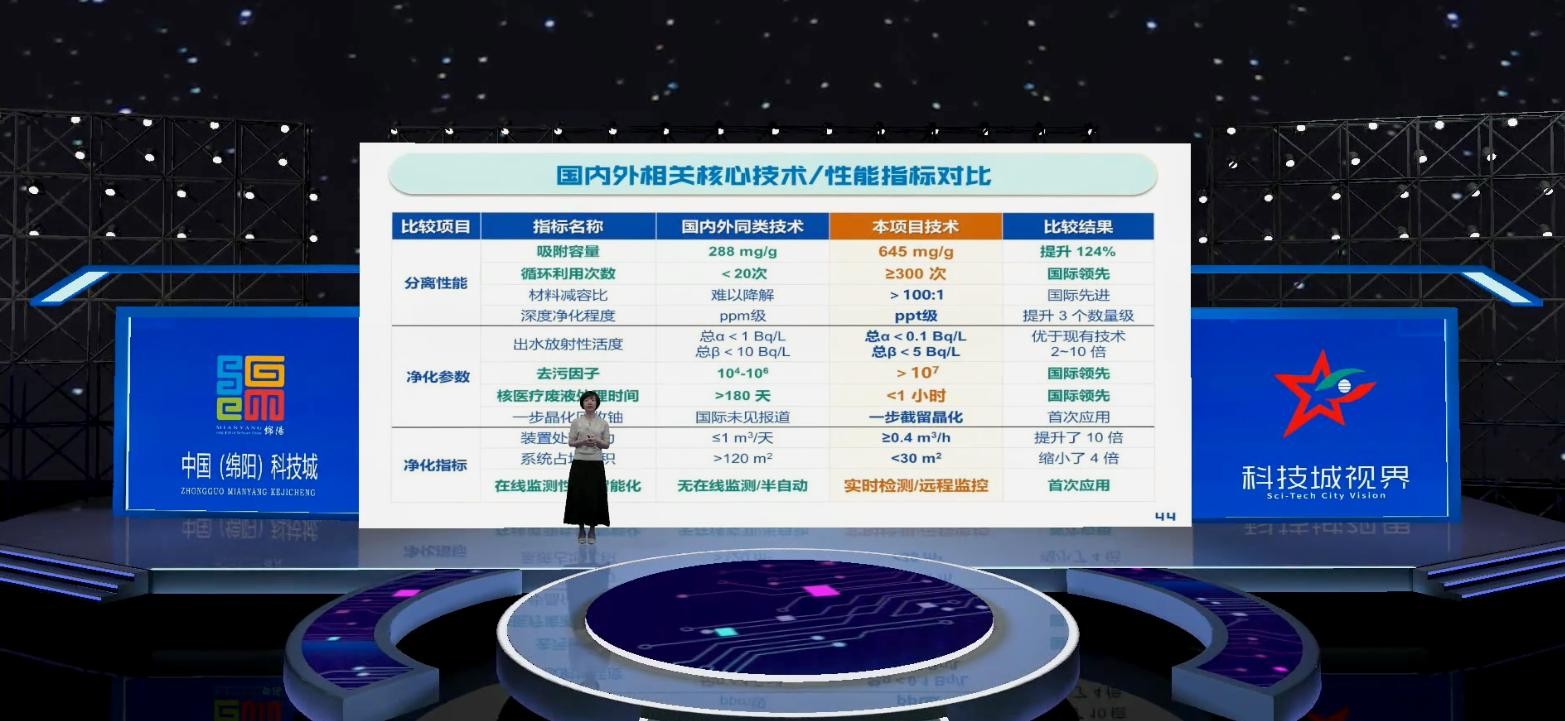
In the area of nuclear medicine liquid waste treatment, the R&D team has launched integrated intelligent equipment featuring staged treatment by waste classification, forming a closed-loop process of "impurity pre-separation — targeted nuclide extraction — full-process online monitoring." For ionic iodine-131, which accounts for a relatively high proportion in clinical settings, the team developed functional fibers with high positive charge density capable of completing adsorption within 30 seconds, achieving an iodine adsorption capacity of 654.8 mg/g. For multi-form iodine contaminants with complex compositions, they developed adaptive flexible molecular cage materials that dynamically adjust pore channels to accommodate different iodine molecular forms, enhancing anti-interference capability. For complexed lutetium-177, which is growing rapidly in clinical use, the team constructed O/N synergistic coordination porous polyimine frameworks capable of achieving trace lutetium retention in high-interference environments such as human excretory waste liquid.
The equipment is also equipped with the team's self-developed AI-based low-background online activity monitoring system, with detection sensitivity below 0.01 Bq/L, and the relevant measurement data have passed CNAS certification. According to reports, this ultra-fast liquid waste purification equipment, customized for tertiary hospital scenarios, has completed full-process hot testing at Mianyang Central Hospital, with effluent indicators surpassing national regulatory standards; a compact iterative model has also undergone on-site validation at Peking Union Medical College Hospital. These achievements are expected to alleviate issues such as insufficient decay tank storage capacity, difficulties in discharge control, and risks of occupational radiation exposure for frontline personnel, providing technical support for the safe and sustainable development of nuclear medicine.
Disclaimer: Information republished from partner media, institutions or other websites is provided for reference and communication purposes only. It does not imply endorsement of its views or verification of its accuracy. Please contact us if any content infringes rights or requires correction.