
Breakthrough in New Bacterial Imaging Agent Developed by UCSF
 Scan to share
Recently, the research team from the Department of Radiology and Biomedical Imaging at the University of California, San Francisco (UCSF), in collaboration with international partners, has achieved important progress in the field of nuclear medicine diagnosis of bacterial infections. The researchers successfully developed and validated a novel PET (positron emission tomography) radiotracer—2-deoxy-2-[¹⁸F]-fluoro-scyllo-inositol ([¹⁸F]FSK)—capable of detecting active Staphylococcus aureus in vivo with high sensitivity and high specificity.
Staphylococcus aureus is one of the major pathogens causing severe and even life-threatening infections worldwide. In particular, the rampant spread of methicillin-resistant Staphylococcus aureus (MRSA) has made rapid and accurate detection of infection foci a key challenge for effective infection control and guiding clinical treatment. Led by Dr. David Wilson at UCSF, the team innovatively synthesized the [¹⁸F]FSK tracer by exploiting the unique metabolic pathway of Staphylococcus aureus. This tracer overcomes the limitation of conventional imaging modalities in distinguishing sterile inflammation from bacterial infection, enabling precise targeting and visualization of active staphylococcal communities.
To facilitate clinical translation of this technology, the research team also established an efficient and robust chemoenzymatic radiosynthesis process for [¹⁸F]FSK, greatly simplifying the production workflow and laying a solid foundation for future large-scale clinical application. The related findings were recently published in the authoritative nuclear medicine journal Journal of Nuclear Medicine. The co-first authors of the article are Jung Min Kim and Sang Hee Lee, and the corresponding author is Dr. David Wilson.
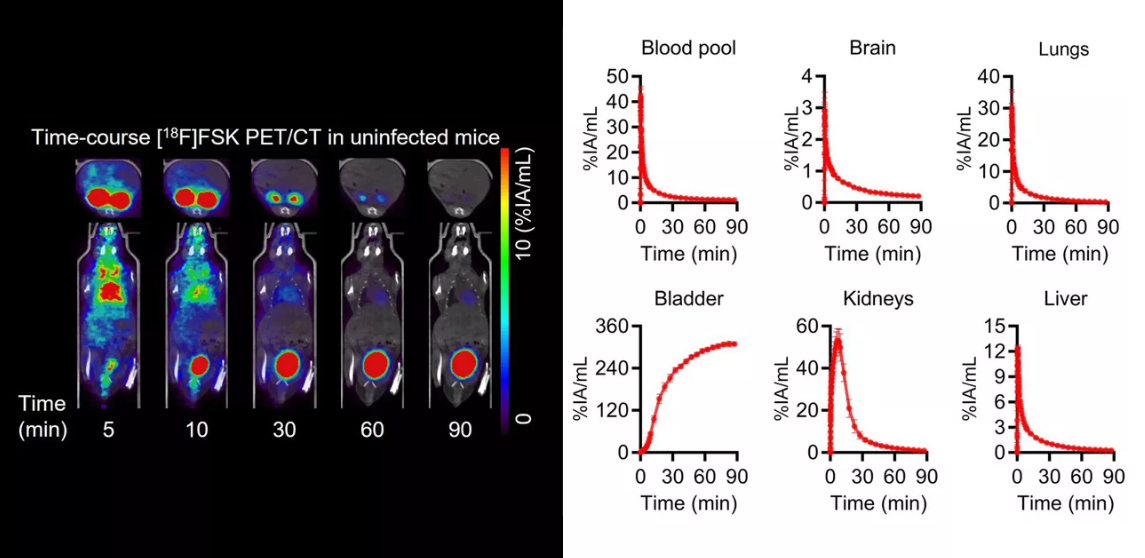
In preclinical PET/CT imaging and time-course analysis in uninfected mice, the researchers observed that [¹⁸F]FSK signal distributed rapidly in vivo and then declined over time, primarily excreted through the kidneys and bladder, demonstrating favorable in vivo biosafety and pharmacokinetic profiles. In mouse models inoculated with methicillin-resistant Staphylococcus aureus, longitudinal PET/CT images clearly showed gradually increasing radioactive uptake signal at the infection foci over time, confirming the great potential of [¹⁸F]FSK for real-time in vivo monitoring of Staphylococcus aureus infection.
Disclaimer: Information republished from partner media, institutions or other websites is provided for reference and communication purposes only. It does not imply endorsement of its views or verification of its accuracy. Please contact us if any content infringes rights or requires correction.