
Russia's Bureau 1440 tests satellite communications on nuclear icebreaker
 Scan to share
Recently, the Russian private aerospace company “Bureau 1440” (Bureau 1440), part of ICS Holding, together with the Northern Sea Route Directorate, the “Atomflot” Federal State Unitary Enterprise under the State Atomic Energy Corporation Rosatom, and the Federal Medical-Biological Agency (FMBA), successfully completed field tests of a new-generation domestic low-orbit satellite communication system under actual navigation conditions along the Northern Sea Route.
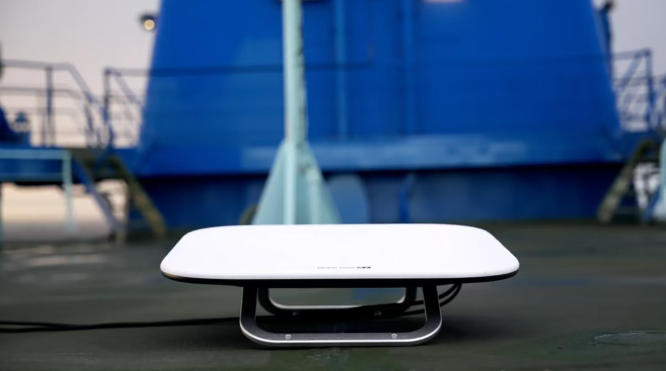
The tests were conducted aboard the Project 22220 universal nuclear icebreaker “Ural” (Ural), on whose hull a mass-produced user terminal “1440.ULTRA” (1440.ULTRA), developed independently by Bureau 1440, was installed. During the tests, the ship's captain, Viktor Suryadov (Viktor Suryadov), successfully connected via the satellite communication system to the “Atomflot” situational center in Murmansk by video conference and reported in real time on the voyage mission and ice conditions; meanwhile, medical personnel from the Pirogov Murmansk Multidisciplinary Center of the Federal Medical-Biological Agency also successfully conducted a telemedicine consultation with experts at the Burnasyan Federal Medical Biophysical Center (Burnasyan Federal Medical Biophysical Center) in Moscow via the system, successfully transmitting radiological diagnostic and other medical examination data of a crew member.
This is the first time in Russian history that stable high-latitude communications have been successfully achieved on an icebreaker via independent low-orbit space and ground infrastructure. Dmitry Agafonov (Dmitry Agafonov), Deputy General Director of Bureau 1440, stated that the solution has proven in practice its full capability to adapt to the complex temperature and operating conditions of the Northern Sea Route. Svyatoslav Stepchenkov (Svyatoslav Stepchenkov), First Deputy General Director and Director of Navigation Support of the Northern Sea Route Directorate, and Yakov Antonov (Yakov Antonov), General Director of “Atomflot,” both noted that the system has laid a solid foundation for establishing a unified closed-loop digital management system for the fleet and ensuring the safety of Arctic navigation.
As the builder of Russia's equivalent of the “Starlink” (Starlink) low-orbit satellite internet project, Bureau 1440 is committed to creating a constellation of hundreds of low-orbit spacecraft, functioning like 5G base stations in orbit to provide ground and transportation users with high-speed broadband and low-latency services of up to 1 Gbit/s. With the future improvement of global coverage of the constellation, this technology will provide stable and reliable broadband internet access to vessels across the entire waters of the Northern Sea Route, including routes to the North Pole, thoroughly resolving the long-standing problems of communication gaps and limited bandwidth in high-latitude regions.
Disclaimer: Information republished from partner media, institutions or other websites is provided for reference and communication purposes only. It does not imply endorsement of its views or verification of its accuracy. Please contact us if any content infringes rights or requires correction.