
Russian Researchers Develop Tungsten Carbide Composite Material with Tunable Hardness
 Scan to share
Recently, the Institute of Chemistry and Technology of Rare Elements and Mineral Raw Materials under the Kola Science Centre of the Russian Academy of Sciences, in collaboration with the Institute of North Industrial Ecology Problems, successfully developed an advanced synthesis process for depositing nanoscale tungsten carbide coatings on carbon fiber surfaces and achieved precise control of the material's hardness. The relevant research results have been published in the Russian Chemical Bulletin.
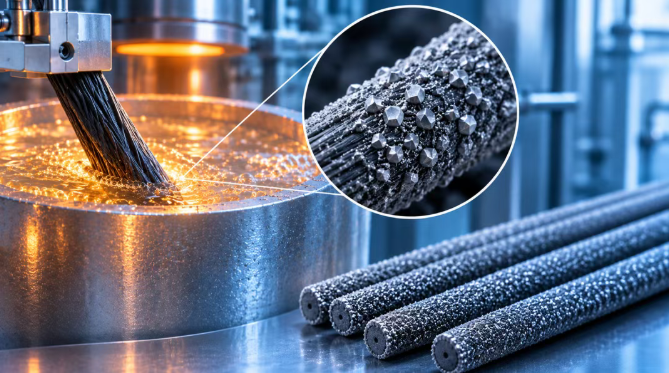
The research team employed molten salt electrochemical synthesis technology, using "Carbopon B 22" grade carbon fiber as the substrate, placing it in a molten salt of sodium chloride, potassium chloride, and tungsten-containing salts at 750—900 °C. By switching electrochemical synthesis modes, the researchers achieved continuous customization of the coating's phase composition and mechanical properties:
Current-free mode: preferentially generates a uniform film of high-hardness tungsten monocarbide (WC) (only tens of nanometers thick), enabling the composite material to achieve an elastic modulus as high as 672 GPa, greatly enhancing resistance to extreme mechanical loads, suitable for microsensors and high-wear components.
Galvanostatic/pulsed mode: increases the proportion of the "softer" tungsten semicarbide (W₂C) phase to 65%, growing hundreds-of-nanometer-scale crystals on the fiber surface, with the elastic modulus tunable to 524 GPa, significantly increasing the specific surface area and phase interfaces, providing ideal micro-morphology for chemical catalyst and electrocatalyst supports.
Researcher Vladimir Dolmatov noted that this research is part of the project of the Russian Engineering Center for Arctic Solid Mineral Mining and Integrated Ecological Balanced Processing Technologies. The Kola Science Centre has previously successfully achieved the deposition of tantalum, niobium, molybdenum, and chromium carbides on carbon fiber, and will soon release relevant data on titanium carbide. This "carbon fiber–refractory metal carbide" composite material not only retains the lightweight and high-strength physical properties of carbon fiber but also combines the excellent hardness and electrocatalytic activity of tungsten carbide (particularly in reactions such as hydrogen peroxide decomposition). This achievement opens up broad application prospects for nuclear microsensors, deep-space exploration structural components, selective adsorbents, and highly active electrocatalytic substrates under extreme physical environments.
Disclaimer: Information republished from partner media, institutions or other websites is provided for reference and communication purposes only. It does not imply endorsement of its views or verification of its accuracy. Please contact us if any content infringes rights or requires correction.