
MEPhI Develops Non-Destructive Testing Device for Microfuel of High-Temperature Gas-Cooled Reactors
 Scan to share
Recently, the research team led by Tatyana Borisovna Aleyeva, Associate Professor of the Department of Theoretical and Experimental Physics of Nuclear Reactors at the National Research Nuclear University “Moscow Engineering Physics Institute” (MEPhI), announced that it is about to complete the development of an experimental device for non-destructive testing of uranium content in fuel compacts for innovative high-temperature gas-cooled reactors (HTGR).
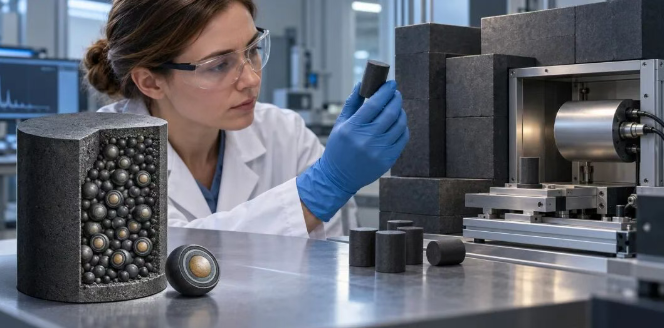
It is reported that the helium temperature at the core outlet of the 200 MW HTGR under design can reach 850°C, aiming to provide high-potential heat for large-scale nuclear hydrogen production process stations (AETS). Its fuel uses graphite cylindrical compacts with a height of 5 cm and a diameter of 12.5 mm, and each compact contains approximately 4,000 uniformly distributed microfuel particles with a diameter of less than 1 mm, featuring uranium dioxide kernels and multilayer ceramic coatings. In response to the deviations in particle count and uranium enrichment caused by the complex manufacturing process, high-precision non-destructive testing has become the key to ensuring fuel quality.
The testing device is developed based on the active neutron method. The system uses a graphite moderator cube weighing about 3 tonnes and a plutonium-beryllium (Pu-Be) isotopic neutron source to generate a thermal neutron flux, inducing stimulated fission of uranium inside the compacts; a helium-3 (He-3) counter tube detection unit with a cadmium shielding layer is installed above, and by recording the fast neutron response intensity and comparing it with standard samples, relative quantitative measurement with high sensitivity and low background is achieved.
This device developed by MEPhI can ensure high-precision verification of uranium content in fresh fuel compacts before they are loaded into fuel assemblies (TVS). This technological breakthrough fills the core quality inspection link in Russia's HTGR fuel production process chain, laying a solid technical foundation for the construction of subsequent industrial-scale nuclear hydrogen production demonstration projects.
Disclaimer: Information republished from partner media, institutions or other websites is provided for reference and communication purposes only. It does not imply endorsement of its views or verification of its accuracy. Please contact us if any content infringes rights or requires correction.