
Installation of key components of the core catcher for Unit 4 of Leningrad NPP Phase II completed
 Scan to share
The under-construction Unit 4 of Leningrad NPP Phase II has recently reached a key engineering milestone: the engineering team of the general contractor TITAN-2 successfully positioned and secured the maintenance platform and cantilever truss of the core catcher (the core passive safety system “molten core catcher”) precisely in the reactor shaft. The two large components weigh 78 tonnes and 148 tonnes respectively. Following the installation of the first batch of components (the catcher vessel and internal filler materials) in the summer of this year, another breakthrough has been achieved in the assembly of large structures for this core safety facility.
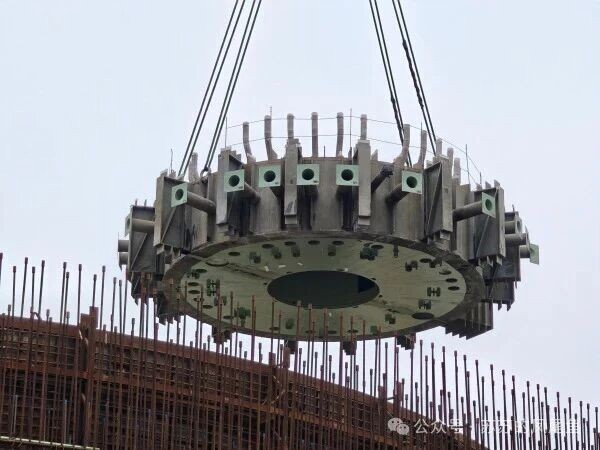
As the core barrier of the defense-in-depth system of the Generation III+ pressurized water reactor (VVER-1200), the core catcher is mainly used to receive, retain and continuously cool the molten core under severe accident conditions, fundamentally preventing the molten core from penetrating the containment bottom slab and releasing radioactive substances into the external environment. The cantilever truss and maintenance platform lifted in this operation are not only responsible for system condition monitoring and ensuring access for routine maintenance, but also perform the important functions of shielding against extreme high temperatures and blocking neutron and gamma radiation, effectively protecting the concrete building structures around the shaft and personnel safety.
During this lifting operation, the on-site engineering team fully applied cross-construction technology, breaking the procedural barrier of the traditional model in which installation could only begin after civil construction was fully completed, and achieving parallel operation of large mechanical equipment installation and civil construction of the reactor shaft. Yevgeny Milushkin, Director of the Capital Construction Administration of Leningrad NPP, noted that this construction method has been fully proven highly reliable in the construction of earlier units; through rigorous cross-disciplinary coordination, it significantly shortens the construction period while ensuring high-quality construction, and optimizes the allocation of materials and manpower. According to the overall project schedule, the reactor pressure vessel of Unit 4 is to be lifted into place in 2029.
Konstantin Khudyakov, project manager of TITAN-2, stated that the main structure construction of the main plant building of Unit 4 has currently reached 30% progress, with wall concreting, embedded part placement, cable and pipe laying, and layered reinforcement work in the core area being advanced in parallel. Once the bottom slab of the last set of core components is in place, the total equipment dead weight of the entire molten core retention system within the shaft space will reach approximately 570 tonnes.
Units 3 and 4 of Leningrad Phase II are planned to be connected to the grid and commissioned in 2030 and 2032 respectively. Alexey Likhachev, Director General of Rosatom, emphasized that the steady progress of the new-generation units will lay the foundation for achieving the national energy strategy goal of raising the share of nuclear power in Russia's total electricity generation from the current 20% to 25% by the mid-2040s. To support this leap in the energy mix, Russia plans to build 38 nuclear energy projects in a coordinated manner, covering diverse technology pathways including large and medium-power pressurized water reactors, fast neutron breeder reactors, and small modular reactors.
Disclaimer: Information republished from partner media, institutions or other websites is provided for reference and communication purposes only. It does not imply endorsement of its views or verification of its accuracy. Please contact us if any content infringes rights or requires correction.