
Global Major SMR Project Progress Review
 Scan to share
As of now, global SMR competition has already formed several different tiers: Linglong One is advancing pre-operational testing, Darlington and Russia's land-based projects have entered the construction phase, Clinch River has just crossed the threshold for a U.S. commercial SMR construction permit, Long Mott is still under licensing review, and representative projects in the UK and South Korea are mainly advancing design and regulatory approval. In subsequent comparisons of these projects, the most valuable indicators will be first fuel load, first criticality, first grid connection, commercial operation, and whether construction can be replicated after the first-of-a-kind unit.
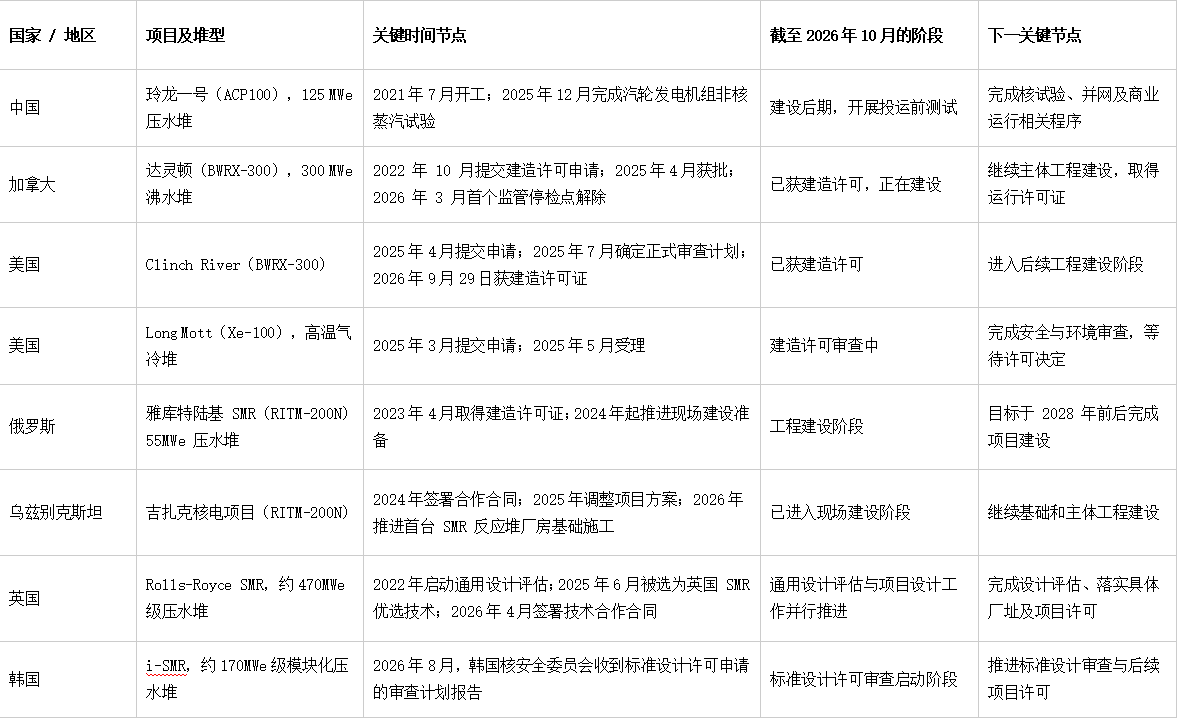
Project progress:
China's Linglong One is one of the more advanced projects among land-based SMR commercial demonstration projects. In December 2025, the project completed non-nuclear steam testing, verifying the functions of conventional island-related systems; public information in early 2026 shows that the project is still conducting pre-operational testing. The project adopts a 125 MWe pressurized water reactor design, mainly targeting applications such as power generation, heating, industrial steam, and seawater desalination.
Canada's Darlington project is one of the earliest projects in the global BWRX-300 technology line to enter substantive nuclear island construction. The Canadian Nuclear Safety Commission approved construction of the first unit in April 2025, and in March 2026 released the first regulatory hold point corresponding to foundation construction of the reactor building. OPG also submitted an operating license application in March 2026, meaning the project's licensing work has begun to extend toward commissioning and operation after construction completion.
The U.S. Clinch River and Canada's Darlington use the same BWRX-300 design, but the projects are not at exactly the same stage: the Canadian project has already entered physical construction, while the U.S. project obtained a construction permit on September 29, 2026. Therefore, when comparing these two projects, in addition to regulatory licensing, attention should also be paid to nuclear island main construction, key equipment manufacturing, and on-site installation progress.
Russia's land-based RITM-200N project reflects another technology line. The Yakutia project obtained a construction permit in 2023, with the goal of deploying a 55 MWe-class small reactor in the Arctic region; after adjusting the overall plan in 2025, the Uzbekistan project retained two RITM-200N units while also planning to build two VVER-1000 large units. In 2026, the Uzbekistan project has advanced foundation construction for the first SMR reactor building.
The UK and South Korea are currently still mainly in the design and regulatory review stage. The UK's Rolls-Royce SMR has been selected as the preferred technology for the government's SMR program and entered the formal technical design cooperation stage in April 2026; its generic design assessment is still ongoing.
South Korea's i-SMR entered the standard design licensing review process in August 2026, and further work remains before a specific nuclear power plant obtains a construction permit.
Disclaimer: Information republished from partner media, institutions or other websites is provided for reference and communication purposes only. It does not imply endorsement of its views or verification of its accuracy. Please contact us if any content infringes rights or requires correction.