
U.S. Department of Energy Opens Lux Supercomputer to Aid Fusion Design
 Scan to share
Recently, the "Lux" artificial intelligence supercomputer, jointly built by the U.S. Department of Energy (DOE) and Advanced Micro Devices, Inc. (AMD), has officially opened to scientific research users at Oak Ridge National Laboratory (ORNL). The supercomputer is positioned as the first dedicated "AI Factory" of the DOE's "Genesis Mission," aimed at providing computing power support for frontier scientific research including fusion plant design and river forecasting.
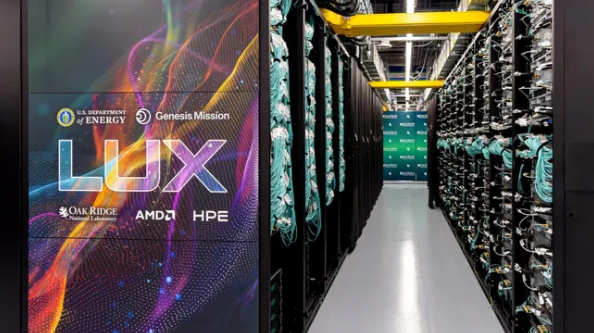
In terms of computing performance and hardware configuration, the "Lux" supercomputer ranked 14th on the TOP500 list published in November 2026, achieving 220.79 petaflops of floating-point computing capability, with its primary focus on low-precision AI math. The system is operated by the Oak Ridge Leadership Computing Facility (OLCF) under Oak Ridge National Laboratory, built with direct-liquid-cooled "HPE ProLiant Compute XD685" servers, and interconnected via an 800G Ethernet network composed of "HPE Juniper Networking QFX" switches.
In terms of key hardware components, AMD provided nearly the full set of internal core components for "Lux," including "EPYC" CPUs, "Instinct MI355X" GPUs, "Pensando" networking, and the "ROCm" software stack. Data published by the Oak Ridge Leadership Computing Facility shows that the entire system comprises more than 500 nodes and more than 4,000 "MI355X" GPUs equipped with 288GB of high-bandwidth memory (HBM3E), with a total system high-bandwidth memory capacity of approximately 1.1 petabytes (PB), each node equipped with more than 24TB of local non-volatile storage, and each GPU equipped with a 400G network interface card. Users can also access the "Orion" file system with a capacity exceeding 600PB, originally built alongside the "Frontier" supercomputer.
It is reported that of the 3.5 million node-hours of computing power provided annually by "Lux," half will be directly allocated to scientific research work related to the "Genesis Mission," focusing on tackling energy and meteorological challenges such as fusion plant design, while the remaining computing resources will be open to social commercialization, further accelerating the integration of artificial intelligence and high-performance computing in scientific research and industry.
Disclaimer: Information republished from partner media, institutions or other websites is provided for reference and communication purposes only. It does not imply endorsement of its views or verification of its accuracy. Please contact us if any content infringes rights or requires correction.