
Russian Modeling Study on Hydrogen Permeation in Tungsten of Thermonuclear Reactors
 Scan to share
Recently, experts from the "Budker Institute of Nuclear Physics, Siberian Branch of the Russian Academy of Sciences" (ИЯФ СО РАН) and the "Nikolsky Mathematical Institute, Peoples' Friendship University of Russia" conducted mathematical modeling of hydrogen permeation in tungsten under thermonuclear reactor conditions. Hydrogen appears when plasma contacts the material surface, and if hydrogen penetrates deep into the material, it may reduce the strength of the structure; the relevant research results were published in the Lobachevskii Journal of Mathematics and supported by the Russian Science Foundation.
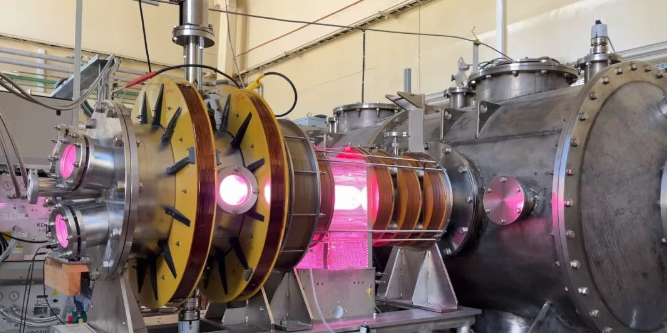
According to reports, in previous experiments of this type, physicists studied only the propagation of hydrogen near the tungsten surface. Russian scientists modeled the heating of tungsten to 1200 Kelvin (K) and the hydrogen diffusion process, and recorded an anomalous Soret effect. The study found that when hydrogen-trapping defects exist in the crystal structure of tungsten, the temperature gradient acts as an effective pump, transporting this chemical element deep into the material; if hydrogen reaches the tungsten-copper structure located several millimeters deep, it will degrade the strength of that region.
Currently, multiple experimental thermonuclear reactors worldwide are under construction or in the design phase, including the largest International Thermonuclear Experimental Reactor (ITER), as well as projects advanced by individual countries, such as China's Experimental Advanced Superconducting Tokamak (EAST), Korea's Korea Superconducting Tokamak Advanced Research (KSTAR), and Russia's Tokamak with Reactor Technologies (ТРТ). Regardless of the scale and configuration of the devices, they all face the common problem of first wall material selection, namely withstanding the extreme heating caused by contact with plasma, and modeling typical processes is an important stage in advancing the field of controlled thermonuclear fusion.
At the "Nikolsky Mathematical Institute, Peoples' Friendship University of Russia," a team of mathematical modeling experts is conducting research on plasma confinement in open traps, thermonuclear materials science, and the design of materials with specified superconducting properties, with most related tasks built on close cooperation with the plasma laboratory of the "Budker Institute of Nuclear Physics, Siberian Branch of the Russian Academy of Sciences."
"Corresponding Member of the Russian Academy of Sciences, Professor at the Nikolsky Mathematical Institute, Peoples' Friendship University of Russia" Galina Lazareva stated that mathematical modeling in the field of controlled thermonuclear fusion is one of the most complex tasks, characterized by the need to describe processes across multiple orders of magnitude in time and space, involving hydrodynamic and kinetic descriptions of plasma dynamics, radiation processes, impurity ionization and charge exchange, high-energy neutron transport, plasma-wall interaction, and plasma instability modeling. The task of the jointly funded project with the "Budker Institute of Nuclear Physics, Siberian Branch of the Russian Academy of Sciences" is to create tools for studying material erosion through mathematical modeling.
Although the first wall of the "International Thermonuclear Experimental Reactor" will be made of tungsten, research teams continue to study this material. "Junior Researcher at the Budker Institute of Nuclear Physics, Siberian Branch of the Russian Academy of Sciences" Vladimir Popov stated that the team simulates the processes occurring inside solids when materials are subjected to plasma-related effects such as laser pulses or electron beams. In addition to the most common tungsten, they also study ceramics and various composite materials. These efforts are important not only for the "International Thermonuclear Experimental Reactor" but also for projects such as the "Tokamak with Reactor Technologies" and the "Gas Dynamic Magnetic Trap" (ГДМЛ); he added that hydrogen is produced when plasma irradiates the first wall surface, with part reflected and part entering the interior and undergoing random walk diffusion. If it reaches the tungsten-copper joint, which is the most vulnerable part of the plasma-facing components, it will increase the brittleness of that region and reduce the overall structure's tolerance to plasma heating.
Mathematical modeling of hydrogen diffusion deep into tungsten has considered various defects such as grain boundaries in the single-crystal structure, which the experts call "traps." "Junior Researcher at the Budker Institute of Nuclear Physics, Siberian Branch of the Russian Academy of Sciences" Vladimir Popov stated that defects on the one hand suppress diffusion, and on the other hand generate forces that pull hydrogen toward the cold regions of the material. The research team demonstrated in their paper the existence of an anomalous Soret effect mechanism that may make hydrogen concentration deeper in the material higher than near the surface. This pattern is important not only for hydrogen but also applies to tritium, which behaves similarly, and helps to analogize the accumulation of radioactive isotopes deep in tungsten.
It is understood that in the future, Russian experts plan to conduct experiments on the "Helicon Source Materials Science Device" (ГИМП) at the "Budker Institute of Nuclear Physics, Siberian Branch of the Russian Academy of Sciences" to investigate the effects of hydrogen on different materials and continue to expand the mathematical models. "Corresponding Member of the Russian Academy of Sciences, Professor at the Nikolsky Mathematical Institute, Peoples' Friendship University of Russia" Galina Lazareva stated that the next stage of mathematical modeling is to solve inverse problems, thereby using all actual experimental data to determine process characteristics, for example, studying cluster effects near saturated vapor by simulating melt rotation, and then modeling the erosion impact of thermal currents on thermonuclear reactor divertor components, and relying on institute experiments to more accurately reproduce various aspects of the physical modes of reactor operation.
Disclaimer: Information republished from partner media, institutions or other websites is provided for reference and communication purposes only. It does not imply endorsement of its views or verification of its accuracy. Please contact us if any content infringes rights or requires correction.