
Russian Tomsk Polytechnic University Develops Fast Power Supply for Synchrotron Radiation
 Scan to share
Recently, the engineering team at Tomsk Polytechnic University in Russia has made important progress in the development of core equipment for large-scale scientific facilities, successfully developing a prototype high-precision programmable current source (FC current source) for fast correction magnets for the new “SILA” synchrotron radiation and free electron laser complex, and has fully launched the next stage of comprehensive testing.
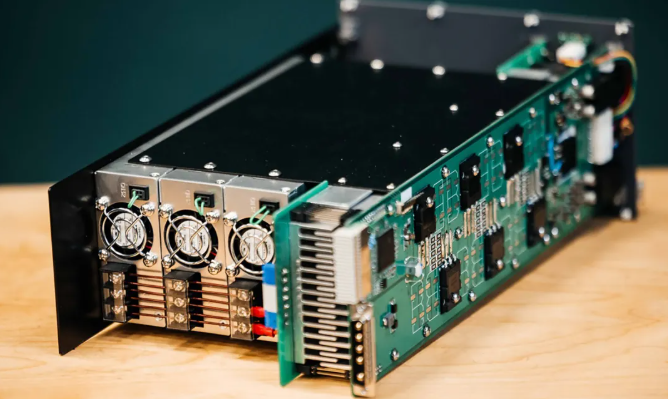
As an important support for the “SILA” project, the FC current source is designed to achieve fast current regulation over a wide range and high-precision output. Compared with conventional power supplies, this device not only needs to achieve current formation accuracy of up to 200 ppm, but must also be rapidly regulated within the -5 to +5 A range, with an output voltage of up to ±40 V, thereby effectively accelerating the rate of current change in inductive windings and fully meeting the stringent technical requirements of the beam dynamic stabilization system.
At the same time, experts from the Department of Electronic Engineering at the School of Non-Destructive Testing and Safety Engineering of the university are simultaneously advancing the improvement of the prototype programmable current source for the main winding of quadrupole magnets, in order to provide a stable current of up to 110 A and an output voltage of +36 V to ensure precise focusing of the particle beam. The project is being implemented on commission from “TomIUS-PROJECT” LLC, and the integration of the power supplies with the facility automation control system is being coordinated by engineers from the Department of Nuclear Fuel Cycle at the School of Nuclear Technology Engineering.
Pavel Baranov, Dean of the School of Non-Destructive Testing and Safety Engineering, stated that modern synchrotron magnet systems place extremely high and differentiated requirements on the precision, stability, and speed of current sources, and the research team is committed to creating a series of domestically produced programmable current sources that meet the standards of new-generation accelerator complexes. The “SILA” (“Synchrotron—Laser”) project is planned for construction in Protvino, Moscow Region, Russia, and is a large-scale scientific research complex combining a 6 GeV fourth-generation synchrotron radiation light source with a free electron X-ray laser, which will in the future broadly serve frontier scientific research in physics, chemistry, and materials science.
Disclaimer: Information republished from partner media, institutions or other websites is provided for reference and communication purposes only. It does not imply endorsement of its views or verification of its accuracy. Please contact us if any content infringes rights or requires correction.