
CAS and Russia's MBIR Fast Reactor Deepen Cooperation
 Scan to share
Recently, the Institute of Modern Physics of the Chinese Academy of Sciences and the limited liability company "MBIR International Research Center Consortium Lead Entity" formally signed a multilateral cooperation agreement. The two sides defined a comprehensive cooperation framework on the platform of the International Research Center for the sodium-cooled multipurpose fast neutron research reactor (MBIR), and will focus on in-depth scientific research on Accelerator Driven System (ADS) related technologies, materials science research, and neutron utilization, marking a breakthrough in practical cooperation between China and Russia in the interdisciplinary field of advanced nuclear energy and large-scale scientific facilities.
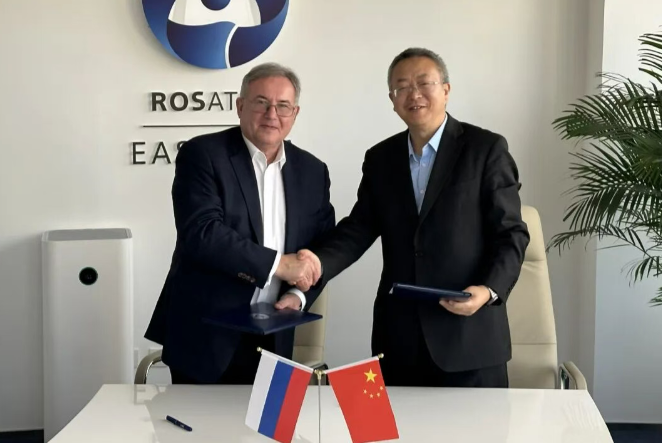
As China's largest comprehensive research center in the field of heavy ion physics and its applications, the Institute of Modern Physics of the Chinese Academy of Sciences has long undertaken the construction and operation of major national science and technology infrastructure. The institute is not only responsible for operating the Heavy Ion Research Facility in Lanzhou (HIRFL), but also fully participates in the construction of the High Intensity Heavy-ion Accelerator Facility (HIAF), and, as the lead institution of China's Accelerator Driven Transmutation Research Facility project, has accumulated profound engineering and theoretical expertise in nuclear transmutation technology and heavy ion physics research.
He Yuan, Deputy Director of the Institute of Modern Physics of the Chinese Academy of Sciences, stated that the MBIR reactor complements existing accelerator-based basic research with critically important neutron experimental capabilities. The core cooperation directions explicitly locked in the agreement, such as Accelerator Driven Systems (ADS) and neutron science, are highly aligned with the country's current strategic urgent needs in advanced nuclear energy systems and research on irradiation damage mechanisms of nuclear materials, and will provide researchers with an unprecedented high-flux fast neutron experimental validation platform.
Located at the site of the State Scientific Center—Research Institute of Atomic Reactors in Dimitrovgrad, Russia, MBIR is a sodium-cooled multipurpose fast neutron research reactor with a thermal power of 150 MW, and is included in Russia's national leading project "New Nuclear Energy and Energy Technologies." At present, the installation of the reactor's primary circuit equipment is advancing at full speed. Following the successful positioning of the cold filter-trap of the emergency heat removal system circuit and the transition joints of the hot pipeline, two emergency heat exchangers with a total weight of 14.6 tons have recently been successfully installed in their design positions, laying a solid engineering foundation for the full completion of the reactor.
Vasily Konstantinov, General Director of the limited liability company "MBIR International Research Center Consortium Lead Entity," pointed out that the outstanding professional capabilities of the Institute of Modern Physics of the Chinese Academy of Sciences in heavy ion physics research and accelerator technology will play an irreplaceable and important role in formulating the overall MBIR research program. As the consortium continues to attract international institutions including the Joint Institute for Nuclear Research and the Institute of Nuclear Physics of the Academy of Sciences of the Republic of Uzbekistan, this open research platform is accelerating the convergence of global advantageous innovation resources.
By deeply integrating into the MBIR international research consortium, the Chinese research team will obtain valuable experimental resources needed with priority for carrying out the peaceful uses of atomic energy program. This transnational scientific research cooperation has pressed the "fast-forward button" for accelerating the development of dual-component nuclear energy, breaking through the bottlenecks of closed nuclear fuel cycle technology, and promoting the commercial construction of safe fourth-generation nuclear power units, and has far-reaching strategic demonstration significance for the collaborative innovation of global nuclear energy and large-scale scientific projects.
Disclaimer: Information republished from partner media, institutions or other websites is provided for reference and communication purposes only. It does not imply endorsement of its views or verification of its accuracy. Please contact us if any content infringes rights or requires correction.