
U.S. Nuclear Industry Virtual Assistant NIVA Officially Launched in North America
 Scan to share
Recently, the nuclear industry virtual assistant "NIVA" has completed its testing phase and officially entered production use at nuclear power plants across North America. The project was jointly developed by the "Electric Power Research Institute" (EPRI), the "Institute of Nuclear Power Operations" (INPO), and the "Nuclear Energy Institute" (NEI). Since its debut in August 2026, leveraging decades of technical, regulatory, and operational experience, it has provided utilities with tools such as a knowledge assistant and an operating experience assistant, aimed at accelerating licensing and maintenance work and helping new personnel quickly acquire professional knowledge.
Regarding the project initiation and governance mechanism, it is reported that the "Institute of Nuclear Power Operations," the "Electric Power Research Institute," and the "Nuclear Energy Institute" each possess massive independent databases, and in the past, utility company staff had to search across multiple databases using inconsistent methods. At an industry conference, Joseph Dominguez, CEO of "Constellation," urged the three organizations to establish a unified artificial intelligence application solution and provided initial pilot funding; the three organizations advanced development with the support of chief nuclear officers, with the "Institute of Nuclear Power Operations" as sponsor, the "Electric Power Research Institute" responsible for project management, and an oversight committee composed of the "Institute of Nuclear Power Operations," the "Electric Power Research Institute," the "Nuclear Energy Institute," and "Constellation" leading the creation, with "Pacific Gas & Electric," "Southern," "Ontario Power Generation," and "NextEra Energy" subsequently invited to join the committee.
Regarding the technical architecture and data security design, the project was initiated in December 2024 and formally advanced in January 2025, initially called the "Nuclear Industry Large Language Model." Robert Austin, "Senior Project Manager of the Operating Plant Program at the Electric Power Research Institute," stated that from the outset all parties made clear they would not input industry data into the language model for fine-tuning, to avoid losing data control; instead, they selected through competitive bidding the "Retrieval-Augmented Generation" (RAG) federated tool developed by "Atomic Canyon," with the main framework running at the "Institute of Nuclear Power Operations," accessing independent databases located at different sites via the internet, while strictly maintaining existing member access permissions, contractual agreements, and intellectual property controls.
Regarding model training and system integration capabilities, it is reported that "NIVA" employs the "FERMI" artificial intelligence model designed by "Atomic Canyon" for nuclear industry information retrieval, built on the "Frontier" exascale supercomputer at "Oak Ridge National Laboratory" and trained on more than 53 million pages of publicly available data from the "U.S. Nuclear Regulatory Commission" (NRC), while also supporting access to the latest revisions and older versions of "U.S. Nuclear Regulatory Commission" regulatory guides, and providing citation information that can be clicked for traceability and download. The system supports integration with utility companies' general artificial intelligence tools through the "Model Context Protocol" (MCP), and can combine plant-specific confidential performance information collected by the "Institute of Nuclear Power Operations" through the "Industry Reporting and Information System" (IRIS). Kelli Voelsing, "Senior Director of Engineering and Risk at the Nuclear Energy Institute," stated that previously five different systems had to be logged into to complete searching, downloading, and uploading, whereas now it can be done through a one-stop operation, and the three organizations have reported relevant experience to the "U.S. Nuclear Regulatory Commission."
Regarding workforce empowerment, new reactor support, and pilot applications, as new entrants and existing operators advance new projects, "NIVA" can help new employees become familiar with abbreviations, terminology, and processes. Ramon Martinez, "Vice President of Data Analytics at the Institute of Nuclear Power Operations," stated that new companies focus not only on primary systems but also on secondary systems, which are equally critical; even for special reactors such as molten salt reactors, general equipment such as pumps, air compressors, valves, circuit breakers, and electrical equipment have deep operational experience available for reuse. The beta pilot launched in early 2026 covered six utility companies, including "Constellation," which operates 21 nuclear reactors. Brian Carroll, "Head of Nuclear Digital Strategy at Constellation," stated that "NIVA" reflects the real challenges employees face daily and supports fleet-wide deployment; Kelli Voelsing stated that in the pilot exit survey, 82% of respondents said they would be somewhat disappointed or very disappointed if they could no longer access "NIVA," and the tool has been opened to members of the "Institute of Nuclear Power Operations" and the "World Association of Nuclear Operators Atlanta Centre" (WANO Atlanta Centre), covering operating nuclear power plants in Canada, Mexico, Romania, and South Africa, while the UAE's "Barakah nuclear power plant" is also advancing related agreements.
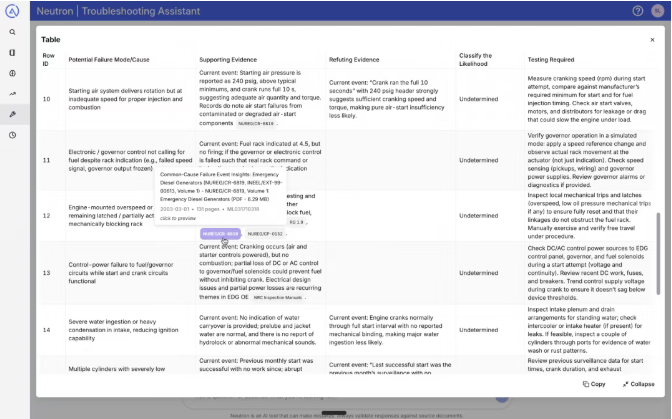
It is understood that "NIVA" passed security testing by an independent company before entering production, is deployed on the plant business network and strictly isolated from plant protection systems, and runs on the "Microsoft Azure" platform using standard artificial intelligence models rather than agentic models that carry the risk of breaking through the test environment. It is reported that its "troubleshooting assistant," derived from the operating experience and knowledge transfer tools, is in beta and expected to be released before the end of 2026, capable of generating within seconds or minutes a supporting and refuting evidence table containing dozens to hundreds of rows of data to assist in troubleshooting equipment faults; Brian Carroll stated that this is precisely the original design intent of "NIVA," namely built by the industry for the industry.
Disclaimer: Information republished from partner media, institutions or other websites is provided for reference and communication purposes only. It does not imply endorsement of its views or verification of its accuracy. Please contact us if any content infringes rights or requires correction.