
Middle East Powers Accelerate Civil Nuclear Energy Strategic Deployment
 Scan to share
Recently, the United Arab Emirates and Saudi Arabia are comprehensively accelerating civil nuclear energy construction, positioning it as a core pillar for ensuring long-term energy security, promoting economic diversification, and achieving climate resilience goals. As a civil nuclear energy pioneer in the Gulf Cooperation Council, the United Arab Emirates, following the full commercial operation of the 5.6 GW Barakah Nuclear Energy Plant, is entering a new evolutionary phase led by the Emirates Nuclear Energy Corporation (ENEC). Meanwhile, Saudi Arabia has also formally incorporated nuclear energy into its "Vision 2030" strategic framework through the signing of significant bilateral nuclear energy cooperation agreements, marking the Middle East region's civil nuclear energy development entering a new phase of leapfrog advancement.
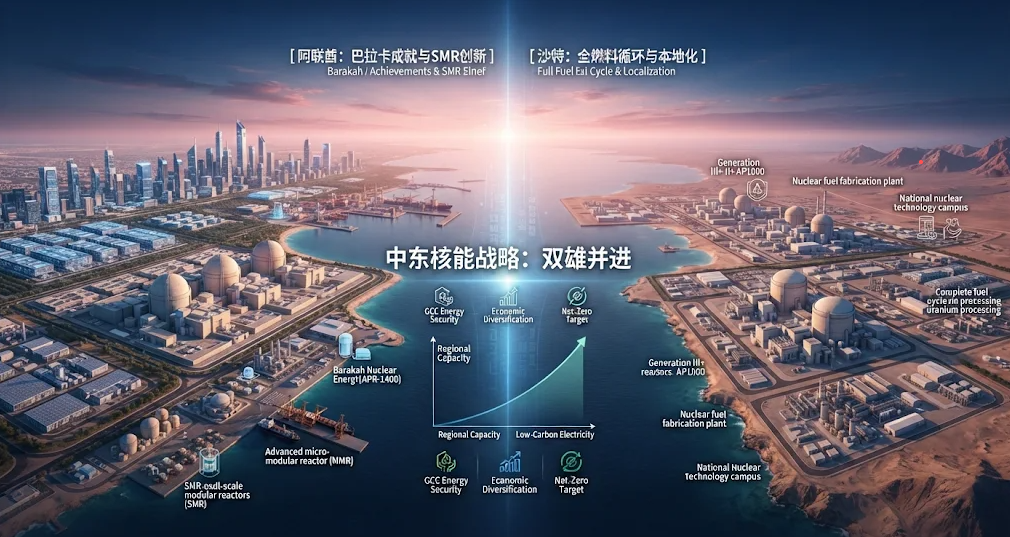
In the United Arab Emirates, nuclear energy development is extending toward diversification and deep engagement with cutting-edge technologies. Facing strong demand from artificial intelligence data centers for zero-carbon baseload power, ENEC is evaluating tender proposals to double its commercial reactor fleet and simultaneously promoting the incubation of Small Modular Reactors (SMRs) and Advanced Modular Reactors (AMRs). ENEC has initiated a multi-phase assessment with GE Vernova Hitachi Nuclear Energy for the deployment of the BWRX-300 Small Modular Reactor; meanwhile, Abu Dhabi's EHC Investment has signed a memorandum of understanding with U.S.-based NANO Nuclear Energy to introduce 15 MW high-temperature gas-cooled microreactors for providing shore power and decarbonization support to large ports such as Khalifa Port and remote industrial zones. Regarding nuclear fuel, the United Arab Emirates has consistently adhered to a fully open, non-domestic fuel cycle model, strictly abiding by international non-proliferation commitments.
Saudi Arabia, meanwhile, has presented an ambitious blueprint covering the entire nuclear fuel cycle. With the Saudi Ministry of Energy having signed a 30-year civil nuclear energy cooperation agreement with the United States, the National Project for Atomic Energy (NPAE) and the Nuclear Holding Company (NHC) are comprehensively coordinating international procurement and asset cooperation. Saudi Arabia plans to introduce Generation III+ large commercial reactors, with key evaluation of mature reactor types including Westinghouse's AP1000, Korea Electric Power Corporation's APR-1400, and Électricité de France's EPR, to replace domestic fossil fuel consumption and unlock crude oil export value. Unlike the United Arab Emirates, Saudi Arabia aims to establish a complete domestic nuclear fuel cycle system encompassing uranium exploration, yellowcake production, and low-enriched uranium manufacturing.
In response to the two countries' nuclear energy expansion plans, the UAE Federal Authority for Nuclear Regulation (FANR) and Saudi Arabia's Nuclear and Radiological Regulatory Commission (NRRC) have both established legal frameworks for civil liability for nuclear damage aligned with international standards, strictly attributing third-party liability to operators, and have signed international treaties such as the Vienna Convention on Civil Liability for Nuclear Damage. With both countries fully opening up in the areas of engineering construction, supply chain participation, localized joint ventures, and regulatory compliance, civil nuclear energy construction in the United Arab Emirates and Saudi Arabia is creating enormous regional market opportunities for global nuclear power engineering general contractors, equipment suppliers, and legal advisory firms.
Disclaimer: Information republished from partner media, institutions or other websites is provided for reference and communication purposes only. It does not imply endorsement of its views or verification of its accuracy. Please contact us if any content infringes rights or requires correction.