
China Nuclear Industry General Hospital Launches IAEA International Peer Review of Radiotherapy Quality Control
 Scan to share
Recently, the launch meeting of the "IAEA QUATRO Radiotherapy Quality Control System International Peer Review" and the unveiling ceremony of the IAEA "Rays of Hope" Anchor Center Training Base were officially held at the Nuclear Industry General Hospital. IAEA international experts, He Jianrong, Party Secretary and Director of China Nuclear Medical, and relevant representatives of the General Hospital attended the event.
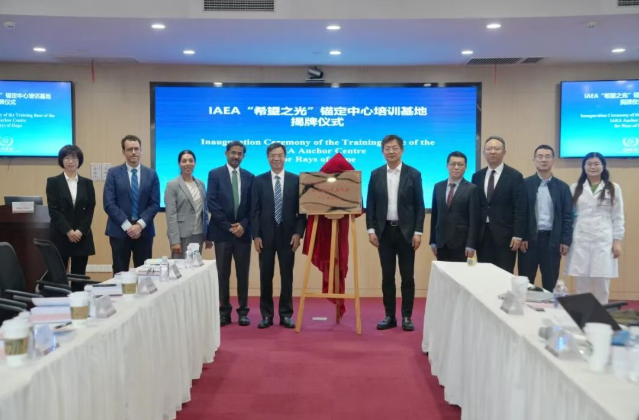
It is understood that the General Hospital, as a national team, has achieved fruitful results in nuclear medicine, radiation injury treatment, and nuclear emergency medical rescue. This international peer review is a continuation and expansion of the hospital's hosting of the IAEA QUATRO Asia-Pacific Regional Training Course, and the General Hospital has thus become the first medical institution in China to undergo international independent audit evaluation. China Nuclear Medical awarded the General Hospital the IAEA "Rays of Hope" Anchor Center Asia-Pacific Regional Training Base, aiming to promote its construction into a standardized, high-level nuclear medical talent incubation platform and thereby deepen international cooperation.
From October 26 to 30, 2026, IAEA national experts from Australia and India will conduct a 5-day QUATRO (Quality Assurance Team for Radiation Oncology) peer review of the General Hospital's oncology department. QUATRO is the IAEA's core method for radiotherapy quality auditing, marking a key step for the General Hospital to comprehensively align with international standards and safeguard the bottom line of tumor diagnosis and treatment safety.
China Nuclear Medical stated that it will continue to deepen the cooperation framework with the IAEA and coordinate the advancement of "bringing in" and "going global." Relying on the talent cultivation and technology empowerment system, it will fully leverage the regional radiation role of the Anchor Center, help the Asia-Pacific region and developing countries worldwide enhance cancer diagnosis and treatment capabilities, and contribute to the international development of nuclear medicine.
Disclaimer: Information republished from partner media, institutions or other websites is provided for reference and communication purposes only. It does not imply endorsement of its views or verification of its accuracy. Please contact us if any content infringes rights or requires correction.