
The 18th National Symposium on Radiopharmaceuticals and Labeled Compounds Held in Chongqing, Focusing on Alpha Nuclide Targeting and Theranostics
 Scan to share
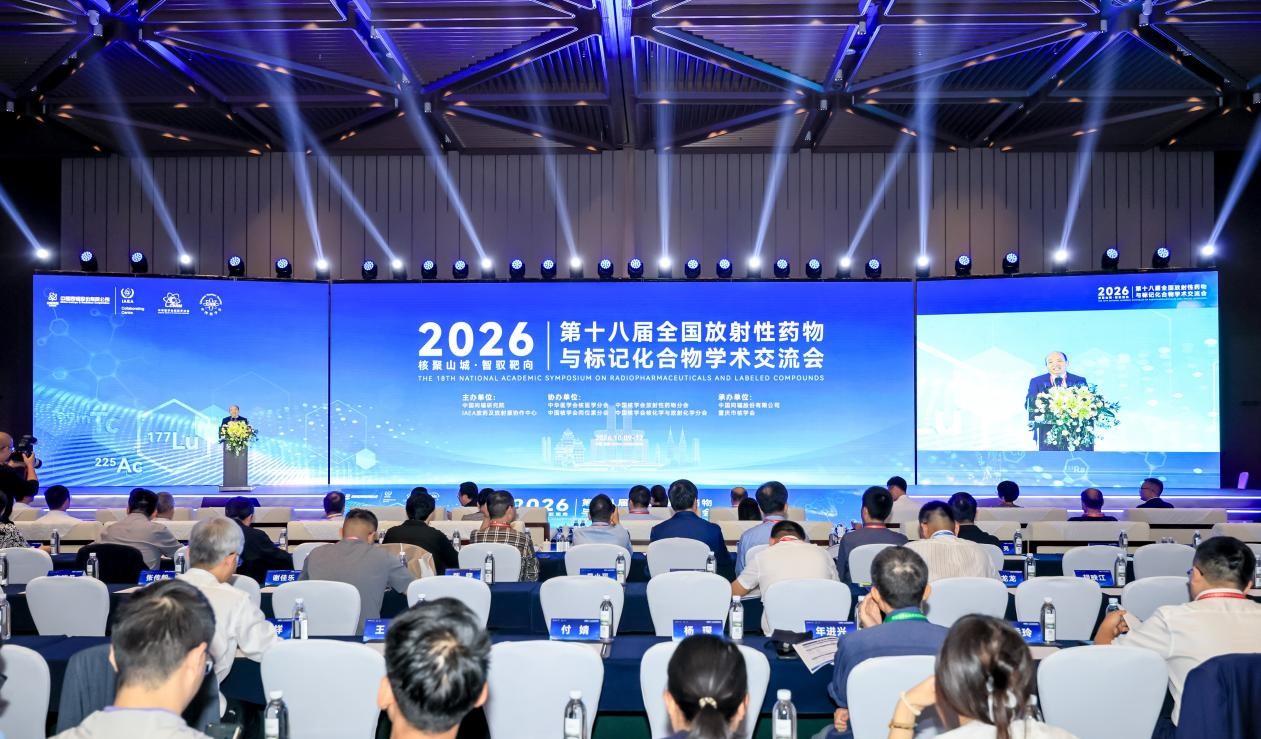
The 18th National Symposium on Radiopharmaceuticals and Labeled Compounds was held on October 10-11 at the Chongqing Science Hall. The conference was co-hosted by the China Isotope & Radiation Corporation Research Institute and the IAEA Collaborating Centre for Radiopharmaceuticals and Radioactive Sources, co-organized by the Nuclear Medicine Branch of the Chinese Medical Association, the Isotope Branch of the Chinese Nuclear Society, the Radiopharmaceuticals Branch of the Chinese Nuclear Society, and the Nuclear Chemistry and Radiochemistry Branch of the Chinese Nuclear Society, and undertaken by China Isotope & Radiation Corporation and the Chongqing Nuclear Society. More than 400 experts, scholars, clinicians, and enterprise representatives from universities, research institutes, medical institutions, and the pharmaceutical industry across the country gathered together to conduct systematic discussions on frontier topics such as the preparation of medical nuclides, research and development of novel radiopharmaceuticals, and clinical application and translation.
At present, the rapid evolution of global precision medicine is driving profound restructuring of the radiopharmaceutical industry. Radiopharmaceuticals that combine precise diagnosis with targeted killing properties have entered a historic window of development. The focus of research and development is shifting from traditional β emitters to α nuclides, which feature high linear energy transfer (LET), short range, and minimal damage to adjacent healthy tissue. Targeting vectors are also extending from small molecules and antibodies to peptides, bispecific antibodies, and nanobodies, while the integration of artificial intelligence (AI) technology has significantly accelerated nuclide chelation design and the calculation and assessment of individualized patient absorbed doses. In China, the full implementation of the Atomic Energy Law of the People's Republic of China and the steady rollout of top-level policies such as the Medium- and Long-Term Development Plan for Medical Isotopes (2021—2035) and the Three-Year Action Plan for High-Quality Development of the Nuclear Technology Application Industry have provided strong support for technological breakthroughs and independent innovation across the entire nuclear medicine industry chain.
Liu Yuntao, Executive Chairman of the conference and President of the China Isotope & Radiation Corporation Research Institute, pointed out while presiding over the opening ceremony that this conference aims to comprehensively showcase China's major original research progress in the field of radiopharmaceuticals, directly address bottlenecks in key raw materials and translation barriers, build a high-end collaborative network featuring deep integration of government, industry, academia, research, and medicine, accelerate the movement of frontier achievements out of the laboratory and to the patient's bedside, and help China's radiopharmaceutical industry chain advance toward high-end, large-scale, and fully autonomous and controllable development. Wang Jing, Chair of the Nuclear Medicine Branch of the Chinese Medical Association; Luo Zhifu, President of the Isotope Branch of the Chinese Nuclear Society; Yang Zhi, President of the Radiopharmaceuticals Branch of the Chinese Nuclear Society; Ding Youqian, President of the Nuclear Chemistry and Radiochemistry Branch of the Chinese Nuclear Society; and Nie Hongyan, Director of the Chongqing High-Tech Zone Management Committee, attended the opening ceremony and delivered speeches.
Xiao Yafei, Chairman of China Isotope & Radiation Corporation, said in his speech that the global radiopharmaceutical landscape is comprehensively entering a new stage of "theranostics" from simple auxiliary imaging, and that α nuclide targeted therapy and multimodal molecular imaging probes have become strategic pillars for cultivating new quality productive forces in the pharmaceutical and healthcare industry. He revealed that China Isotope & Radiation Corporation will carry out comprehensive industrialization and clinical translation plans around the core therapeutic nuclides lutetium-177 (Lu-177) and actinium-225 (Ac-225), as well as novel positron emission tomography (PET)-specific imaging agents, promoting the accelerated industrialization of more innovative drugs with independent intellectual property rights.
During the conference, a high-level roundtable forum was held under the theme of "α Nuclide Preparation-Drug Development-Clinical Application and Regulation," gathering representatives from cross-sector institutions including Sichuan University, SPIC Nuclide Tongchuang, the China Institute for Radiation Protection, Atom High-Tech, the Guangdong Institute for Drug Control, and Peking University Cancer Hospital. They conducted systematic dialogue on difficulties across the entire industry chain, including large-scale separation and purification of α radioactive nuclides, drug conjugation stability, quality control of clinical trials, and regulatory compliance for radiopharmaceuticals.
In addition to the roundtable discussions, this conference also set up five sub-venues: diagnostic drugs and molecular probes, nuclide preparation and labeling technology, youth forum, therapeutic drugs and clinical translation, and drug development progress and new technology applications. A total of nearly 80 academic exchange reports were presented, comprehensively showcasing China's latest research breakthroughs in the design, synthesis, and clinical evaluation of radiopharmaceuticals in the fields of nuclear chemistry, radiation medicine, and translational oncology.
Disclaimer: Information republished from partner media, institutions or other websites is provided for reference and communication purposes only. It does not imply endorsement of its views or verification of its accuracy. Please contact us if any content infringes rights or requires correction.