
At the American Society for Radiation Oncology annual meeting, phase 3 clinical results were announced: SBRT radiotherapy for localized prostate cancer achieves long-term control rates comparable to radical prostatectomy and greatly reduces the risk of incontinence.
 Scan to share
A latest phase 3 randomized controlled clinical study announced at the American Society for Radiation Oncology (ASTRO) annual meeting shows that for patients with localized prostate cancer (PCa), stereotactic body radiotherapy (SBRT) demonstrates excellent clinical application potential. Follow-up data show that SBRT is comparable to traditional radical prostatectomy in 8-year biochemical or clinical failure-free rates, and the incidence of urinary incontinence at 5 years after treatment is significantly reduced by nearly 40%.
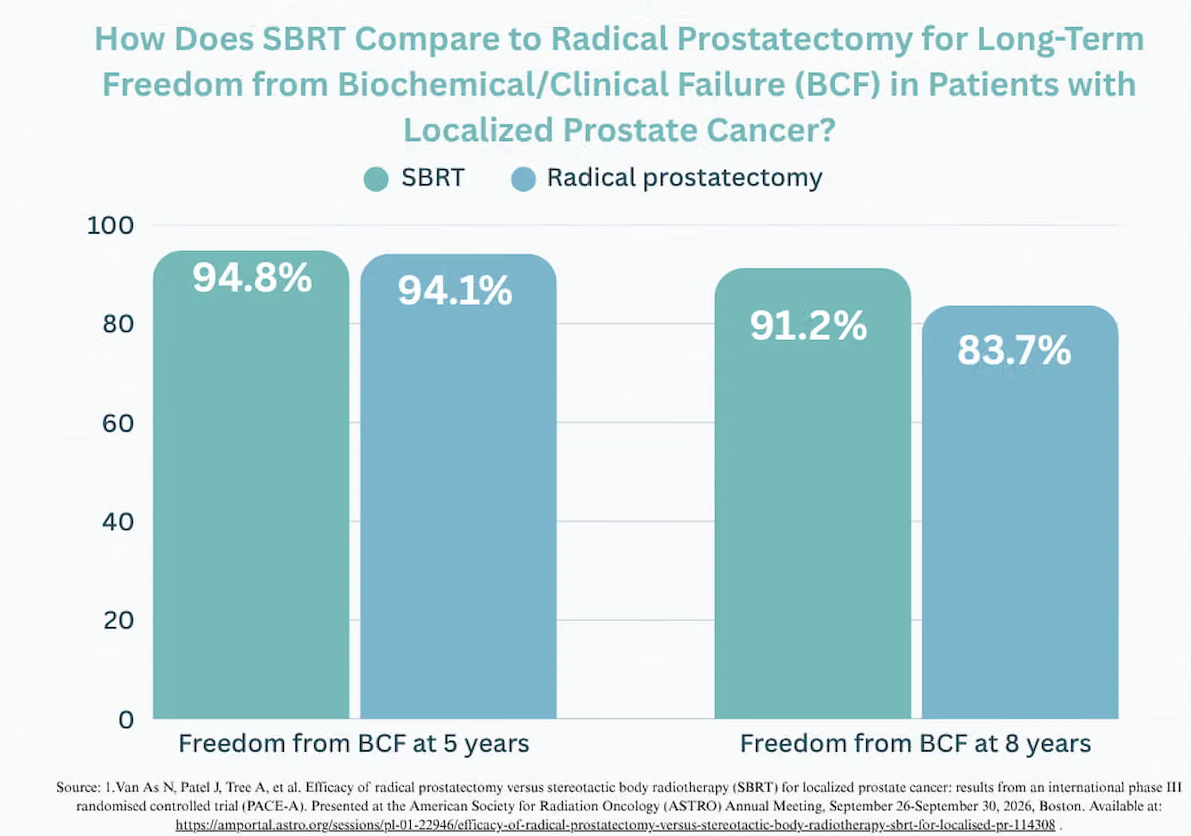
This phase 3 multicenter clinical trial enrolled a total of 123 patients from 8 medical institutions, of whom 63 received SBRT stereotactic radiotherapy and 60 received radical prostatectomy. The median age of enrolled patients was 65.5 years, the median pretreatment prostate-specific antigen (PSA) level was 7.9 ng/mL, and more than 94% of all participants had low-risk or intermediate-risk prostate cancer staging. The study aimed to systematically evaluate whether high-precision external beam radiotherapy can serve as a non-invasive alternative to radical surgery.
In terms of long-term disease control, the 5-year biochemical/clinical failure (BCF)-free rate in the SBRT group reached 94.8%, essentially comparable to 94.1% in the radical prostatectomy group. When follow-up was extended to year 8, the BCF-free rate in the SBRT group remained at 91.2%, versus 83.7% in the surgery group, with no statistically significant difference between the two groups. These long-term follow-up data indicate that precision radiotherapy is not inferior to surgical resection in long-term oncologic control.
The study's lead author, Nicholas van As, MD, medical director of The Royal Marsden Hospital in London, UK, emphasized that for patients with localized prostate cancer, both treatment approaches achieved excellent biochemical control outcomes in long-term follow-up. The results further confirm that SBRT is a safe and effective non-surgical therapy that can provide patients with long-term disease control comparable to traditional surgical resection.
In terms of quality of life and complication assessment, SBRT demonstrated a unique functional preservation advantage. At 5-year postoperative follow-up, the proportion of patients in the SBRT group self-reporting urinary incontinence (defined as using at least one pad per day) was only 8.3%, while the incidence in the radical surgery group was as high as 48%, with the risk of incontinence in the radiotherapy group reduced by nearly 40 percentage points.
In terms of tolerability of toxicities, the distribution of grade 0 to grade 1 mild gastrointestinal (GI) and genitourinary (GU) reactions at 5-year follow-up was similar between the two groups, and the incidence of severe adverse reactions was very low. In the SBRT group, only 1 case of grade 2 or higher gastrointestinal reaction and 2 cases of grade 2 or higher genitourinary reaction were observed, while the surgery group had 1 case of grade 2 or higher genitourinary reaction. Dr. van As pointed out that before making a final clinical decision, physicians should proactively inform patients planning to undergo radical prostatectomy about the SBRT treatment pathway to ensure fully informed consent.
Disclaimer: Information republished from partner media, institutions or other websites is provided for reference and communication purposes only. It does not imply endorsement of its views or verification of its accuracy. Please contact us if any content infringes rights or requires correction.