
U.S. Poll Shows Majority of Respondents Support Prioritizing Permanent Disposal of High-Level Waste
 Scan to share
A recent survey conducted by market research and data analysis company YouGov shows that more than 80 percent of U.S. respondents believe finding a permanent disposal solution for high-level radioactive waste should be a national priority; after learning about relevant technical information, a significant number of respondents viewed deep geological disposal as a credible option.
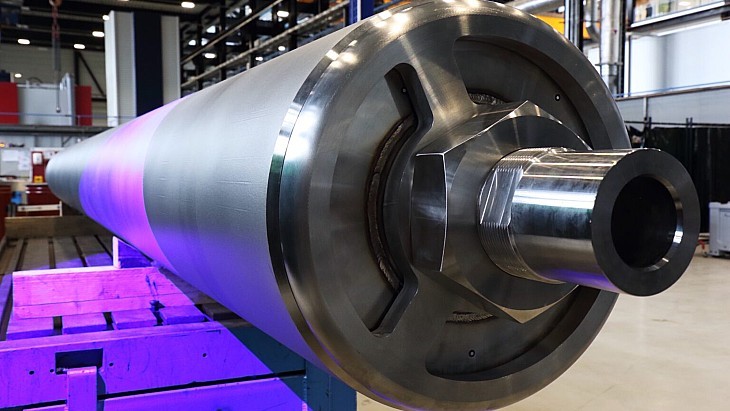
Prototype canister for borehole disposal (Image: Deep Isolation)
The survey was commissioned by nuclear waste disposal technology company Deep Isolation Inc. and conducted in April this year among 1,000 U.S. adults with a nationally representative sample. The survey covered public attitudes toward nuclear energy, concerns about radioactive waste management, support for permanent disposal solutions for spent nuclear fuel and high-level radioactive waste, as well as changes in respondents' views after learning about deep geological disposal and deep borehole disposal technologies.
The survey results show that 81 percent of respondents believe finding a permanent disposal solution for high-level radioactive waste should be a national priority; by comparison, only 28 percent of respondents supported continuing to store spent nuclear fuel at reactor sites for decades. The survey also found that after learning about geological disposal technologies, 65 percent of respondents expressed support for deep borehole disposal as a high-level radioactive waste management option.
Deep borehole disposal is a concept within deep geological disposal, typically involving drilling narrow vertical holes deep into the Earth's crust to isolate radioactive waste in stable rock formations. Since the 1950s, deep borehole disposal has been considered one of the technical pathways for geological isolation of radioactive waste. Countries including Denmark, Sweden, Switzerland, and the United States have proposed related concepts, but none have been implemented to date.
Under Deep Isolation's technical concept, nuclear waste would be encapsulated in corrosion-resistant canisters, typically 9 to 13 inches in diameter (approximately 22 to 33 centimeters) and about 14 feet long (approximately 4.3 meters), which would then be placed in boreholes drilled into rock formations that have been stable for tens of millions to hundreds of millions of years. The company states that its patented technology draws on standard drilling techniques commonly used in the oil and gas industry, utilizing off-the-shelf tools and equipment.
Rod Baltzer, Chief Executive Officer and President of Deep Isolation Nuclear, stated in the foreword to the survey report that the results show the American public wants to advance permanent disposal of high-level radioactive waste and does not want to leave that responsibility to future generations. He also noted that many respondents remain unfamiliar with nuclear waste management practices and still have notable concerns about safety, transportation, and long-term management; the survey also shows that the public has a high degree of trust in scientists and engineers participating in decision-making.
Todd Abrahano, Chairman and Chief Executive Officer of the U.S. Nuclear Industry Council (USNIC), said the study comes at a time when policymakers and industry stakeholders are seeking to advance long-term spent nuclear fuel management strategies. He believes the public support reflected in the survey aligns with growing interest at the state level in exploring full-lifecycle nuclear energy management solutions.
Under the U.S. Nuclear Waste Policy Act, Yucca Mountain in Nevada has been designated since 1987 as the nation's initial repository site for spent nuclear fuel and high-level radioactive waste. The U.S. Department of Energy submitted a construction authorization application to the U.S. Nuclear Regulatory Commission in 2008, but the project was subsequently terminated; nevertheless, Yucca Mountain's legal status as the designated repository remains preserved in U.S. law.
According to data from the World Nuclear Association, as of 2026, the total amount of spent fuel generated by U.S. nuclear power plants is approximately 95,000 metric tons, all of which is stored at existing or decommissioned nuclear power plant sites.
Disclaimer: Information republished from partner media, institutions or other websites is provided for reference and communication purposes only. It does not imply endorsement of its views or verification of its accuracy. Please contact us if any content infringes rights or requires correction.