
Two U.S. National Laboratories Collaborate to Advance Arc-Based 3D Printing of Nuclear Pressure Vessels
 Scan to share
Oak Ridge National Laboratory (ORNL) and Idaho National Laboratory (INL), both under the U.S. Department of Energy (DOE), announced a collaboration focused on advancing wire-arc 3D printing technology for industrial pressure vessels and qualification capabilities for critical nuclear components, aiming to expand the U.S. domestic supply chain.
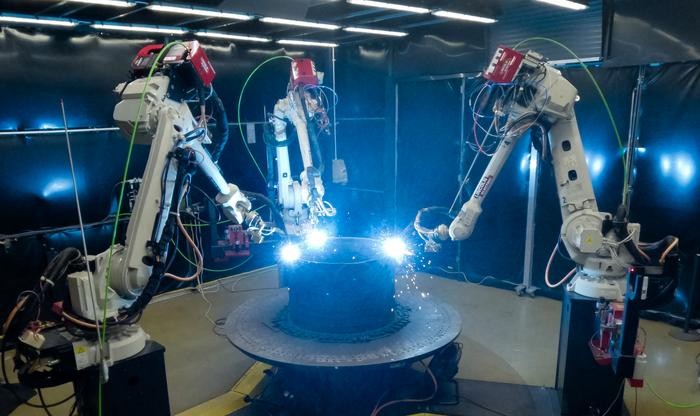
The two laboratories unveiled the collaboration during the Materials and Manufacturing Innovation Day event hosted at Oak Ridge National Laboratory on August 19. The event focused on topics such as advanced manufacturing, nuclear infrastructure, energy security, and domestic supply chains, and featured demonstrations and tours of the DOE Manufacturing Demonstration Facility (MDF). This facility is a large-scale research platform open to industry, primarily used to develop early-stage advanced manufacturing technologies.
Pressure vessels are typically used in demanding environments involving high temperatures and high pressures, requiring high material toughness and structural integrity. Traditional pressure vessels rely heavily on forging processes, but in the context of nuclear energy expansion, domestic manufacturing capacity and supply lead times for large components are under pressure. The two laboratories believe that wire-arc additive manufacturing, which melts metal wire to form components, has the potential to provide a new process route for manufacturing large pressure vessels.
Under the collaboration arrangement, Oak Ridge National Laboratory will leverage its strengths in additive manufacturing, in-situ monitoring, and characterization of printed components, while Idaho National Laboratory will contribute its experience in nuclear reactor component design, testing, deployment, and long-term performance assessment of nuclear materials, working together to integrate component manufacturing, data collection, quality verification, and qualification processes.
In July of this year, researchers at the Manufacturing Demonstration Facility used wire-arc 3D printing technology to produce a small nuclear pressure vessel demonstration component. The component, measuring approximately 3 feet × 5 feet, was printed on ORNL's MedUSA platform using a steel alloy relevant to nuclear applications. The platform uses three coordinated robotic arms to melt metal wire via an electric arc to fabricate complex metal structures. The demonstration component was subsequently exhibited at the Materials and Manufacturing Innovation Day event.
The research team's next step is to focus on validating whether AI-enabled digital tools can assess vessel geometry and material properties in real time during the printing process. Patxi Fernandez-Zelaia, principal investigator at Oak Ridge National Laboratory, stated that the team aims to use data collected during the printing process to manufacture pressure vessel components that meet standard requirements and thereby evaluate their suitability for extreme environments.
In earlier work under this initiative, ORNL also used the same MedUSA printing equipment and related materials to conduct AI-accelerated manufacturing of the R1 Mark-0 neutron sensor bracket for Antares Nuclear Inc. The R1 Mark-0 is a new type of microreactor that achieved criticality at Idaho National Laboratory in June of this year.
Jorgen Rufner, leader of the advanced manufacturing team at Idaho National Laboratory, stated that the project combines the expertise of both laboratories, integrating artificial intelligence, data science, and advanced 3D printing processes to assess component performance in real time during printing, rather than relying entirely on post-production testing.
The two laboratories believe that if the relevant printing and verification methods mature into practical application, they could be used for the manufacturing and qualification of more large metal components in nuclear reactors, and may also serve industries such as chemicals, oil and gas, defense, and aerospace that rely on large metal structural components.
Disclaimer: Information republished from partner media, institutions or other websites is provided for reference and communication purposes only. It does not imply endorsement of its views or verification of its accuracy. Please contact us if any content infringes rights or requires correction.