
Tennessee Issues First-Ever Commercial Fusion-Specific Permit in the U.S. to Type One Energy
 Scan to share
The Tennessee Department of Environment and Conservation (TDEC) has issued Type One Energy the state's first permit specifically for a fusion energy facility, allowing the company to advance fusion-related projects at the Tennessee Valley Authority's (TVA) Bull Run Energy Complex in Clinton. Tennessee officials stated this is the first permit of its kind in the United States issued under a new state-level fusion regulatory framework.
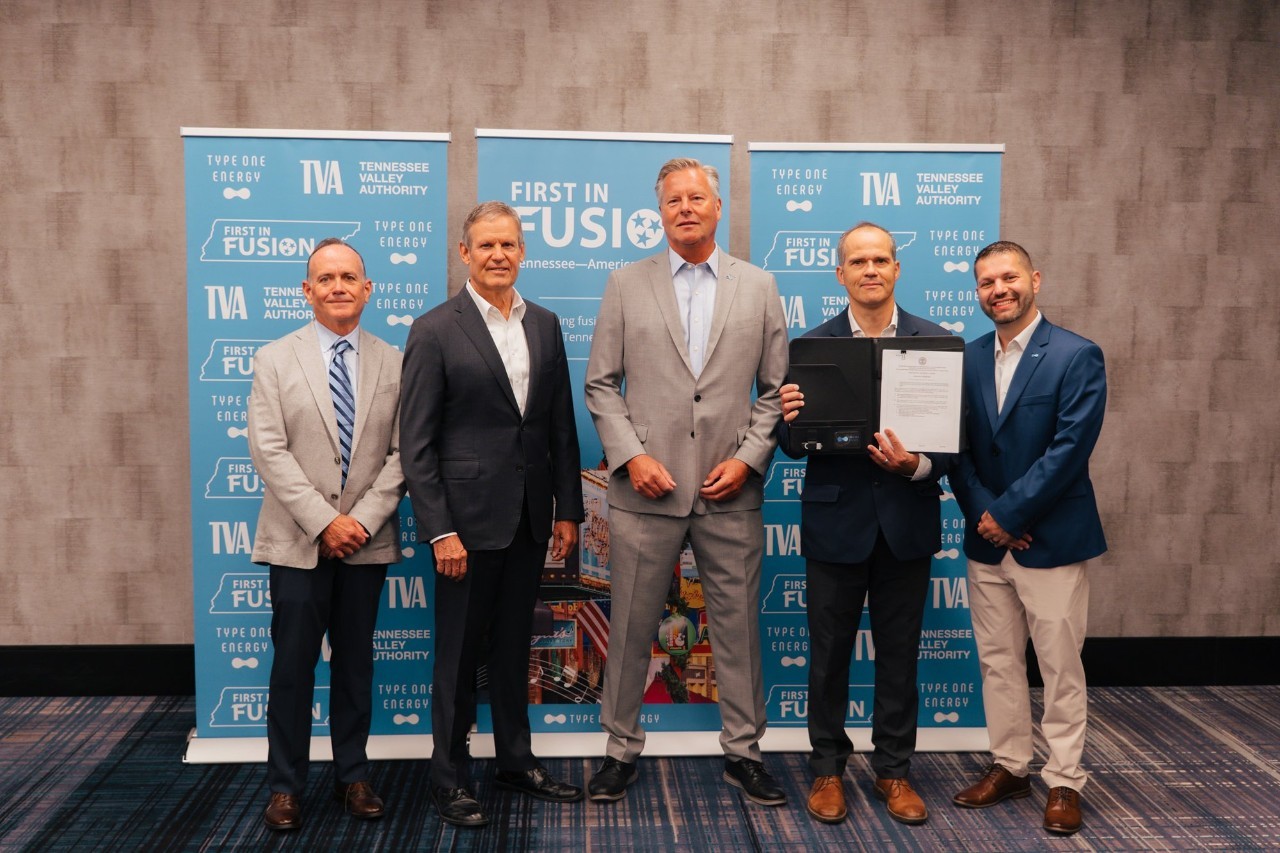
Tennessee Governor Bill Lee, alongside fusion energy partners, presented the first U.S. permit specifically for a commercial fusion facility on Monday at the Organization of American States (OAS) annual meeting in Nashville. (LR) TVA Interim President and CEO Mike Skaggs; Governor Bill Lee; Type One Energy CEO Chris Mowry; Type One Energy Vice President of Regulatory Affairs and Licensing Pascal Dumont; and Type One Energy Radiation Officer Larry Harisis.
The Bull Run Energy Complex is located in Anderson County, across the river from Oak Ridge. Type One Energy plans to launch Phase One of "Project Infinity" at the site, with full operation expected by 2034. The project will establish a fusion technology research and development campus, leveraging partnerships with Oak Ridge National Laboratory (ORNL), TVA, and the University of Tennessee.
Under the project plan, Type One Energy will subsequently advance the "Infinity Two" project, building a stellarator-based fusion power plant with a target grid output of 400 megawatts. The company states the design is based on deuterium-tritium fusion reactions, planned to generate approximately 800 megawatts of fusion power, with 400 megawatts delivered to the grid.
Stellarators are a class of fusion devices that confine high-temperature plasma using complex three-dimensional magnetic fields. Unlike tokamaks, stellarators achieve confinement through specially arranged magnetic coils surrounding the plasma chamber, designed to maintain stable operation without relying on large plasma currents.
This permit also marks the establishment of a clear regulatory pathway for fusion in Tennessee. Previously, the U.S. Nuclear Regulatory Commission (NRC) adopted a regulatory approach for fusion energy production distinct from traditional large fission reactors, delegating relevant oversight responsibilities to qualified states. Tennessee subsequently established a permitting process for fusion facilities and related activities through TDEC's Division of Radiological Health.
Type One Energy stated that "Infinity One" will serve as a prototype and personnel training facility to test technologies needed for future large-scale fusion power plants, with commissioning and startup planned for 2029. If the project proceeds as planned, the Bull Run Energy Complex will become a key test site for advancing U.S. stellarator fusion technology from research and validation to grid-scale application.
Disclaimer: Information republished from partner media, institutions or other websites is provided for reference and communication purposes only. It does not imply endorsement of its views or verification of its accuracy. Please contact us if any content infringes rights or requires correction.