
U.S. Laboratory and Company Collaborate to Advance TRISO Thorium Fuel Development
 Scan to share
Lawrence Livermore National Laboratory (LLNL) in the United States is collaborating with micro nuclear reactor startup AMPERA to advance next-generation reactor fuel development using novel metal particle manufacturing technology. The collaboration focuses on tristructural isotropic (TRISO) coated particle fuel, aiming to provide more durable fuel solutions for advanced reactors operating at higher temperatures and with longer service lifetimes.
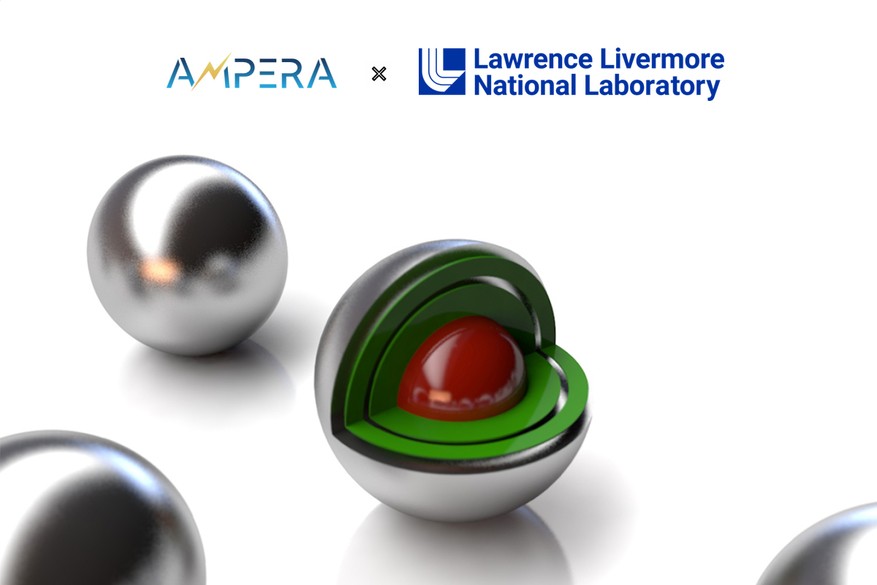
Small modular nuclear fission reactors are viewed as a distributed energy option deployable in remote areas, military installations, and industrial sites. Compared with traditional light-water reactors, some advanced reactors impose stricter requirements on fuel stability under conditions such as high temperature, neutron irradiation, corrosion, and oxidation, which is a key reason TRISO fuel has attracted significant attention.
TRISO fuel particles are typically close to poppy seeds in size, with each particle containing a fuel kernel at its center, surrounded by layers of carbon-based and ceramic-based materials. This structure acts as a miniature containment system, helping to retain radioactive fission products and enhancing the fuel's safety margin and structural stability under demanding operating conditions.
The collaboration project, named "Thorium Single-Mode Droplet Ejection for Reactors (THUNDER)," aims to produce thorium-based precursor particles that can be further processed into TRISO fuel. Thorium as a nuclear fuel material features relatively abundant reserves and shorter-lived associated waste streams. Thorium-232 itself cannot sustain a fission chain reaction, but after absorbing a neutron it can be converted into fissile uranium-233. Therefore, thorium fuel systems typically still require fissile material as a "seed" to initiate and sustain the reaction.
The THUNDER project originates from LLNL's previous laboratory research program "PowderJet." This technology employs a drop-on-demand liquid metal jetting method to produce metal particles with high sphericity and controlled size. For TRISO fuel, the particle size, shape, and composition of the central fuel kernel must be tightly controlled, and this technology is expected to achieve uniformity in scaled production that is difficult to attain with conventional powder preparation methods.
LLNL research engineer and principal investigator Viktor Sukhotskiy stated that this collaboration demonstrates the value of combining national laboratory research capabilities with specific corporate technology needs. AMPERA founder and CEO Brian Matthews noted that the collaboration helps accelerate the development of the technology base required for vertically integrated fuel supply, reducing costs and supply chain risks while supporting the deployment of its compact subcritical nuclear energy systems.
Under the project plan, the two parties' work will cover computational modeling, material and nozzle compatibility testing, high-temperature process development, particle characterization, safe radioactive handling, and the transfer of scalable processes and design rules for future commercialization.
Disclaimer: Information republished from partner media, institutions or other websites is provided for reference and communication purposes only. It does not imply endorsement of its views or verification of its accuracy. Please contact us if any content infringes rights or requires correction.