
Japan's Helical Fusion Technology Selected as Candidate for METI's Fusion Demonstration Program
 Scan to share
Helical Fusion Co., Ltd. has recently been selected as a final candidate for the fusion power demonstration project support program by Japan's Ministry of Economy, Trade and Industry (METI). The program aims to align with Japan's national fusion strategy, advancing fusion energy into the demonstration phase by the 2030s and building the technical foundation for subsequent commercialization.
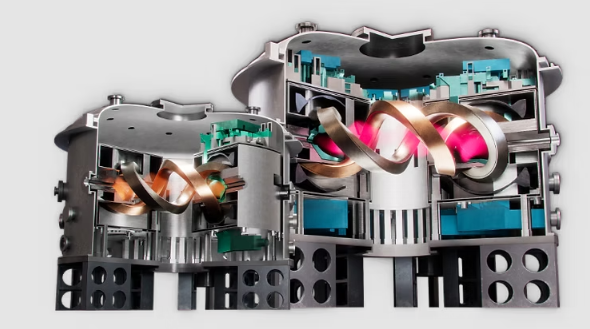
The left image shows Helix HARUKA, Helical Fusion's integrated demonstration device; the right image shows Helix KANATA, Helical Fusion's fusion test plant
Under the current arrangement, the program will provide approximately 60 billion yen in government funding over three years through 2028, supporting private-sector R&D across multiple fusion technology pathways, including tokamaks, stellarators, and laser fusion. The specific funding amount to be awarded to Helical Fusion will be determined after the official grant decision is announced.
Founded in 2021, Helical Fusion is a spin-off company based on research results from Japan's National Institute for Fusion Science (NIFS), primarily developing helical stellarator technology for commercial fusion energy. Unlike some pulsed fusion approaches, stellarators are designed to achieve inherently steady-state operation. The company believes that steady-state operation, net power generation capability, and maintainability are critical conditions that must be simultaneously satisfied for a fusion device to evolve into a commercial power plant.
Japan has a long history of research in helical stellarators. The National Institute for Fusion Science has conducted extensive experiments using the Large Helical Device (LHD), achieving results such as plasma operation sustained for 3,268 seconds and plasma temperatures exceeding 100 million degrees Celsius, while accumulating related plasma control expertise. Helical Fusion is working to translate these research foundations into engineering systems and hardware capabilities.
According to the company's "Helix Plan," it will first develop and validate two key technologies—high-temperature superconducting magnets and integrated blanket/divertor systems—then build the integrated demonstration device Helix HARUKA, and further advance toward the first power-generating fusion device, Helix KANATA. Currently, manufacturing and construction of the high-temperature superconducting magnet demonstration system required for Helix HARUKA is underway in a dedicated workspace on the NIFS campus in Toki City, Gifu Prefecture.
Helical Fusion states that more than 30 Japanese companies are already involved in the development of key components for Helix HARUKA, with partners spanning precision machining, engineering integration, and large-scale energy infrastructure equipment manufacturing. The company aims to establish an engineering foundation for future commercial fusion power generation by combining Japan's stellarator research expertise with domestic industrial manufacturing capabilities.
According to Japan's relevant fusion strategy, the government aims to achieve fusion energy demonstration by the 2030s, evaluating project progress through a milestone-based mechanism. In addition to technical feasibility, participating projects must also conduct validation in areas such as safety, maintenance, community engagement, and industrialization capabilities required for future commercial power plants.
Disclaimer: Information republished from partner media, institutions or other websites is provided for reference and communication purposes only. It does not imply endorsement of its views or verification of its accuracy. Please contact us if any content infringes rights or requires correction.