
UK and US Ports and Shipping Organizations Study Nuclear-Powered Container Ship Deployment Across the Atlantic
 Scan to share
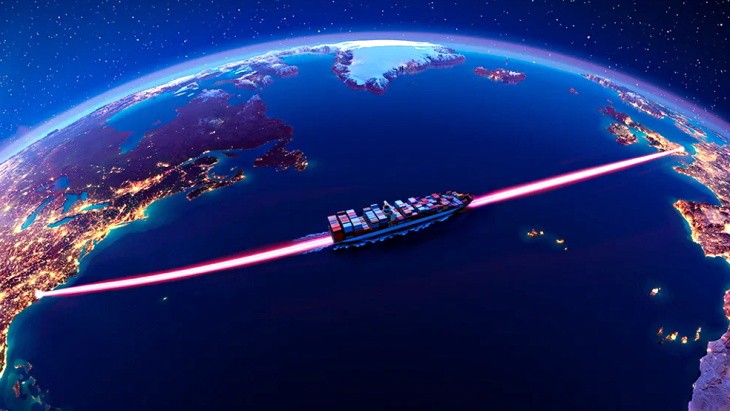
UK classification society and professional consultancy Lloyd's Register, Danish shipping company Maersk, the Port of Charleston in the United States, and the Port of Felixstowe in the United Kingdom are collaborating on the "Pink Corridor" project to study the safety and security requirements involved in deploying nuclear-powered container ships on transatlantic routes.
(Image credit: Lloyd's Register)
The project uses a conceptual nuclear-powered container ship as its research subject, focusing on analyzing the port access conditions and regulatory requirements it may face when operating on a commercial route between the Port of Charleston in South Carolina and the Port of Felixstowe in Suffolk, UK. The research covers ship safety, security measures, cybersecurity, emergency response, insurance systems, and the interface between maritime regulatory and nuclear regulatory requirements.
Lloyd's Register stated that the "Pink Corridor" project aims to provide stakeholders with a structured framework for collaboration, helping ports, shipping companies, and regulators understand the practical requirements, capability gaps, and next steps that need to be clarified before establishing a nuclear-powered maritime transport corridor. The outcomes of the first phase of the project will provide the basis for a potential second phase of research, which may further cover engineering design, regulatory arrangements, legislative needs, and safety and security frameworks.
Nick Gross, Global Container Ship Business Director at Lloyd's Register, stated that this joint development project is an important exploration of nuclear technology entering the commercial shipping sector, and will study the security conditions required for the safe operation of nuclear-powered ships through pragmatic collaboration. He believes that the joint participation of shipping companies, ports, and classification societies reflects the growing interest of the industry in nuclear technology supporting more sustainable maritime operations.
Adam Ramsey, Commercial Director of the Port of Felixstowe, stated that as the largest and busiest container port in the UK, the Port of Felixstowe will provide operational practical experience for the project and support the industry in exploring more long-term sustainable global trade solutions. Tom Boyle, Director of Vessel Operations and Carrier Sales at the South Carolina Ports Authority, stated that the Port of Charleston hopes to study more innovative, economical, and sustainable freight transportation methods, and that the "Pink Corridor" concept project is precisely focused on exploring the feasibility of a nuclear-powered maritime corridor.
This collaboration builds on a previous study conducted by Core Power, Maersk, Lloyd's Register, and the Port of Rotterdam in the Netherlands. That study focused on the safety, operational, and regulatory issues of nuclear-powered container ships calling at EU ports, and noted that the main obstacles to nuclear-powered ships entering ports are not the technology itself, but rather the coordination of local and international regulations, governance arrangements, risk management integration, and public acceptance.
The shipping industry consumes approximately 350 million tonnes of fossil fuel annually, with carbon emissions accounting for about 3% of the global total. The International Maritime Organization (IMO) has approved new greenhouse gas reduction targets, striving to achieve net-zero emissions around 2050. Lloyd's Register previously published a report stating that nuclear energy has the potential to transform the maritime industry through zero-emission propulsion, while extending ship service life and reducing uncertainty in fuel supply and bunkering infrastructure, though commercial application still requires resolving regulatory and safety issues.
Currently, the application of nuclear energy to civilian ships has become a research direction for multiple international organizations and companies. The International Maritime Organization is revising the Code of Safety for Nuclear Merchant Ships, and the International Atomic Energy Agency (IAEA) recently launched a "Maritime Applications" program aimed at supporting the maritime industry in exploring the application of small modular reactors in civilian ship propulsion and offshore energy supply.
Disclaimer: Information republished from partner media, institutions or other websites is provided for reference and communication purposes only. It does not imply endorsement of its views or verification of its accuracy. Please contact us if any content infringes rights or requires correction.