
U.S. Completes Mechanical Property Measurements of Irradiated HALEU TRISO Fuel Particles
 Scan to share
Researchers at the U.S. Department of Energy's Oak Ridge National Laboratory (ORNL) have completed mechanical property measurements of irradiated high-assay low-enriched uranium (HALEU) TRISO fuel particles, providing new experimental data for the development and qualification of next-generation nuclear fuels.
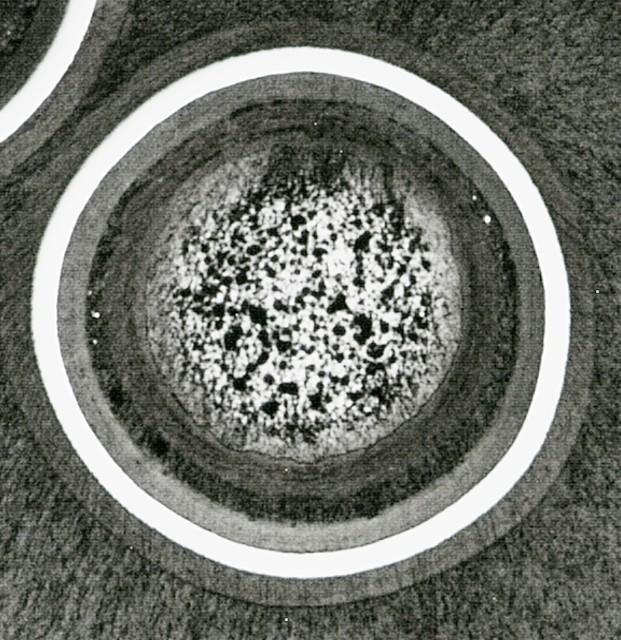
This is an optical cross-sectional image of an irradiated AGR-2 TRISO fuel particle in the Irradiated Fuels Examination Laboratory at Oak Ridge National Laboratory. Image credit: Oak Ridge National Laboratory, U.S. Department of Energy
TRISO fuel, or tri-structural isotropic fuel, features particles coated with multiple protective layers, typically including pyrolytic carbon layers and a silicon carbide layer. This structure provides strong fission product retention capability and is considered one of the key fuel options for advanced reactors, particularly high-temperature gas-cooled reactors. Understanding the property changes of these coatings after irradiation is a critical step in predicting fuel performance under reactor operating conditions.
This study builds on neutron scattering measurements of HALEU-bearing TRISO particles conducted at ORNL earlier this year. Using the laboratory's dedicated indentation testing system for irradiated materials and nuclear fuels, the research team measured the mechanical properties of the inner and outer pyrolytic carbon layers and the silicon carbide layer of TRISO particles from the Advanced Gas Reactor Fuel Development and Qualification Program (AGRFP).
Tests completed at ORNL's Nanomechanics Laboratory revealed changes in the hardness and stiffness of irradiated TRISO particles. The modulus and hardness of the silicon carbide layer decreased, and the pyrolytic carbon layers exhibited corresponding changes as well.
Katherine Montoya, R&D Associate Staff Member in ORNL's Particle Fuel Morphology group, stated that these measurements help compare the performance of TRISO particles in their as-fabricated state against their performance after irradiation under various temperature and burnup conditions. The data will be used to improve nuclear fuel performance models and support further applications of gas-cooled reactor technology.
Disclaimer: Information republished from partner media, institutions or other websites is provided for reference and communication purposes only. It does not imply endorsement of its views or verification of its accuracy. Please contact us if any content infringes rights or requires correction.