
China Launches Global Network for Small Modular Reactor Innovation
 Scan to share
On Tuesday, September 15, during the 70th General Conference of the International Atomic Energy Agency (IAEA) held in Vienna, the China Atomic Energy Authority officially launched the “Global Network for SMR Innovation” (GNSI). The network aims to promote technological progress, standard-setting, and deployment of small modular reactors (SMRs), “helping to improve the safety, economics, and accessibility of nuclear energy in support of climate action and sustainable development.”
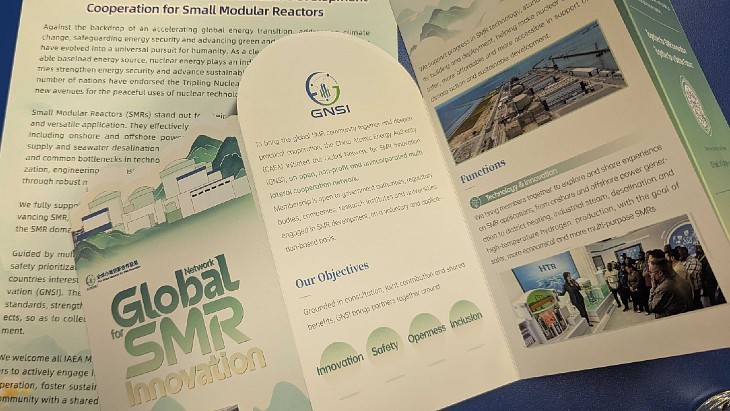
At the launch and promotion event held in Vienna, participants stated that small modular reactors are expected to play a key role in the global expansion of nuclear energy, with applications far beyond conventional power generation, including offshore power supply, high-temperature hydrogen production, district heating, and seawater desalination. The meeting noted that in the face of challenges in technology, regulation, economics, and supply chains, all parties need to engage in multinational cooperation and joint efforts.
The organizers of GNSI emphasized that this “non-profit, non-corporate, and open cooperation mechanism” will serve as a useful complement to the International Atomic Energy Agency. All members join on a voluntary basis, and it is open to government departments, regulatory bodies, enterprises, research institutes, and universities. In terms of organizational structure, the network will establish a council, a secretariat, professional committees, and working groups. It is reported that the first general assembly and founding conference is planned to be held by the end of this year. All members must undertake confidentiality obligations, and intellectual property ownership will be determined through consultation.
During the event, representatives from several Chinese enterprises involved in SMR research and development delivered speeches. The technological achievements presented included the world's first commercial onshore small reactor “Linglong One” (ACP100), whose first unit is currently undergoing commissioning in Hainan, with a rated electric power of 125 MW, a refueling cycle of 24 months, a construction period of 58 months, and a footprint of 20.6 hectares. The meeting also discussed the “Guohe” series (including the Gen III+ GH300 and GH200T, with a thermal power of 200 MW and an electric power of approximately 50 to 60 MW). In addition, the event outlined the high-temperature gas-cooled reactor (HTR-PM) demonstration project and suggested that the newly launched innovation network could facilitate the sharing of practical experience in HTR design, construction, and operation among all parties, “strengthen communication on safety regulation and technical standards, and deepen industrial collaboration through joint research and development, supply chain cooperation, and talent development.”
China General Nuclear Power Group (CGN) stated that its key project is the 200 MW thermal power “HuaPeng-1” integrated natural circulation pressurized water reactor small module. The project is estimated to have a construction period of 36 months and a footprint of approximately 10 hectares. It will provide global partners with “deployment-ready SMR products,” along with end-to-end project services and open SMR research and development for specific scenarios.
Representatives from Pakistan, Thailand, and Nigeria spoke at the meeting, expressing their support for the initiative and exploring cooperation opportunities in potential SMR development and project construction.
IAEA Deputy Director General Huang Wei mentioned the agency's latest projections for future nuclear power installed capacity——up to 1,000 small reactors could be deployed globally by 2060. He stated that the IAEA is “pleased to see China take proactive steps to create a favorable and level playing field for unlocking the maximum potential of nuclear energy. China's launch of this Global Network for SMR Innovation will further consolidate the IAEA's initiatives and efforts in strengthening international cooperation on SMRs.”
Disclaimer: Information republished from partner media, institutions or other websites is provided for reference and communication purposes only. It does not imply endorsement of its views or verification of its accuracy. Please contact us if any content infringes rights or requires correction.